Ultimate Oscillator (ULTOSC)
Summary
Ultimate Oscillator: momentum indicator combining buying-pressure/true-range ratios over three time periods into one 0-100 weighted average. Blends short-, medium-, and long-term momentum to damp single-period noise. Ranges 0-100; conventionally >70 overbought, <30 oversold.
Chart
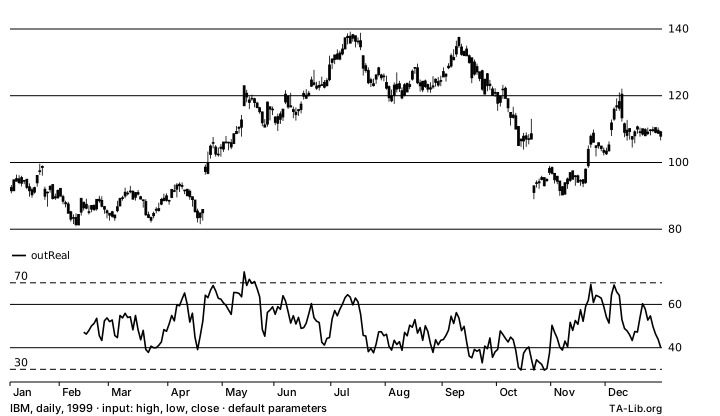
Chart metadata i
Outputs
outReal:line·zero·positive·levels: 30, 70
Formula
trueLow = min(low, prevClose); BP = close - trueLow TR = max(high-low, |prevClose-high|, |prevClose-low|) avg_n = (sum BP over n bars) / (sum TR over n bars) ULTOSC = 100 * (4avg_short + 2avg_mid + avg_long) / 7
Notes
- The three periods are sorted internally, so the 4/2/1 weighting always applies to the shortest, middle, and longest period regardless of the order in which you pass them.
Inputs
inHigh— High price of each barinLow— Low price of each barinClose— Close price of each bar
Outputs
outReal— Ultimate Oscillator value
Parameters
| Parameter | Type | Default | Accepted values | Description |
|---|---|---|---|---|
optInTimePeriod1 | integer | 7 | 1–100000 | Bars for one averaging window |
optInTimePeriod2 | integer | 14 | 1–100000 | Bars for another averaging window |
optInTimePeriod3 | integer | 28 | 1–100000 | Bars for another averaging window |
Properties
Numerical Stability: Start-Independent
| ☐ Overlap Input |
| ✅ Independent Y-Axis i |
| ☐ Candlestick |
| ☐ Display Shift |
| ☐ Can Output NaN or ±Inf |
| ☐ Identity at Period 1 |
| ☐ Uses Transcendental |
| ☐ Input Must Be Positive |
Example
C
#include <stdio.h>
#include <ta_libc.h>

int n = 252;
double high[252]; /* your data, oldest first */
double low[252]; /* your data, oldest first */
double close[252]; /* your data, oldest first */
double out[252];
int outBegIdx, outNBElement;

TA_Initialize();
TA_ULTOSC( 0, n - 1, high, low, close, 7, 14, 28, &outBegIdx, &outNBElement, out );
printf( "%d values from bar %d; last out = %f\n", outNBElement, outBegIdx, out[outNBElement - 1] );
Rust
use ta_lib::Core;

let high = vec![0.0; 252]; // your data, oldest first
let low = vec![0.0; 252]; // your data, oldest first
let close = vec![0.0; 252]; // your data, oldest first
let mut out = vec![0.0; 252];

let core = Core::new();
let range = core.ultosc(0, high.len() - 1, &high, &low, &close, 7, 14, 28, &mut out)?;
println!("{} values from bar {}; last out = {}", range.count, range.beg_idx, out[range.count - 1]);
Java
import io.github.talib.Core;
import io.github.talib.OutRange;

double[] high = new double[252]; // your data, oldest first
double[] low = new double[252]; // your data, oldest first
double[] close = new double[252]; // your data, oldest first
double[] out = new double[252];

Core core = Core.DEFAULT;
OutRange r = core.ultosc(0, high.length - 1, high, low, close, 7, 14, 28, out);
System.out.println(r.count() + " values from bar " + r.begIdx() + "; last out = " + out[r.count() - 1]);
C#
using System;
using TALib;

var high = new double[252]; // your data, oldest first
var low = new double[252]; // your data, oldest first
var close = new double[252]; // your data, oldest first
var outReal = new double[252];

var core = Core.Default;
OutRange r = core.Ultosc(0, high.Length - 1, high, low, close, 7, 14, 28, outReal);
Console.WriteLine($"{r.Count} values from bar {r.BegIdx}; last outReal = {outReal[r.Count - 1]}");
TypeScript
import { ultosc } from 'ta-lib';

const high = new Float64Array(252); // your data, oldest first
const low = new Float64Array(252); // your data, oldest first
const close = new Float64Array(252); // your data, oldest first

const { begIdx, values } = ultosc({ high, low, close }, {
  timePeriod1: 7,
  timePeriod2: 14,
  timePeriod3: 28,
});
console.log(values.length + ' values from bar ' + begIdx + '; last values = ' + values[values.length - 1]);
Implementation
Added in 0.4.0.
TA-Lib Definition: ultosc.c · ultosc.yaml
| Native | File |
|---|---|
| C | ta_ULTOSC.c |
| Rust | ultosc.rs |
| Java | Core_ULTOSC.java |
| C# | Core_ULTOSC.cs |
| TypeScript | ultosc.ts |
Python: talib.ULTOSC, see ta-lib-python.
TA-Lib is also available for R and more using a wrapper.
Aliases
Ultimate Oscillator, UO
See Also
References
- Larry Williams, The Ultimate Oscillator, Technical Analysis of Stocks & Commodities, V.3:4 (1985)