True Range (TRANGE)
Summary
True Range: the greatest of today's high-low span and the two gaps between yesterday's close and today's high/low. Base volatility measure used to build ATR/NATR. Larger values mean wider or gappier bars (higher volatility).
Chart
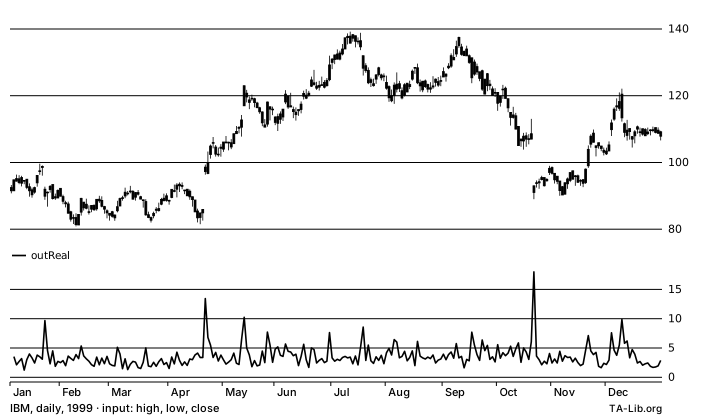
Chart metadata i
Outputs
outReal:line·zero·positive
Formula
TR = max( high - low, |prevClose - high|, |prevClose - low| )
Notes
- The first bar produces no value because it has no prior close; unlike some definitions, it does not fall back to the high-low range for that bar.
Inputs
inHigh— High price of each barinLow— Low price of each barinClose— Close price of each bar
Outputs
outReal— True Range value per bar
Properties
Numerical Stability: Start-Independent
| ☐ Overlap Input |
| ✅ Independent Y-Axis i |
| ☐ Candlestick |
| ☐ Display Shift |
| ☐ Can Output NaN or ±Inf |
| ☐ Identity at Period 1 |
| ☐ Uses Transcendental |
| ☐ Input Must Be Positive |
Example
C
#include <stdio.h>
#include <ta_libc.h>

int n = 252;
double high[252]; /* your data, oldest first */
double low[252]; /* your data, oldest first */
double close[252]; /* your data, oldest first */
double out[252];
int outBegIdx, outNBElement;

TA_Initialize();
TA_TRANGE( 0, n - 1, high, low, close, &outBegIdx, &outNBElement, out );
printf( "%d values from bar %d; last out = %f\n", outNBElement, outBegIdx, out[outNBElement - 1] );
Rust
use ta_lib::Core;

let high = vec![0.0; 252]; // your data, oldest first
let low = vec![0.0; 252]; // your data, oldest first
let close = vec![0.0; 252]; // your data, oldest first
let mut out = vec![0.0; 252];

let core = Core::new();
let range = core.trange(0, high.len() - 1, &high, &low, &close, &mut out)?;
println!("{} values from bar {}; last out = {}", range.count, range.beg_idx, out[range.count - 1]);
Java
import io.github.talib.Core;
import io.github.talib.OutRange;

double[] high = new double[252]; // your data, oldest first
double[] low = new double[252]; // your data, oldest first
double[] close = new double[252]; // your data, oldest first
double[] out = new double[252];

Core core = Core.DEFAULT;
OutRange r = core.trange(0, high.length - 1, high, low, close, out);
System.out.println(r.count() + " values from bar " + r.begIdx() + "; last out = " + out[r.count() - 1]);
C#
using System;
using TALib;

var high = new double[252]; // your data, oldest first
var low = new double[252]; // your data, oldest first
var close = new double[252]; // your data, oldest first
var outReal = new double[252];

var core = Core.Default;
OutRange r = core.Trange(0, high.Length - 1, high, low, close, outReal);
Console.WriteLine($"{r.Count} values from bar {r.BegIdx}; last outReal = {outReal[r.Count - 1]}");
TypeScript
import { trange } from 'ta-lib';

const high = new Float64Array(252); // your data, oldest first
const low = new Float64Array(252); // your data, oldest first
const close = new Float64Array(252); // your data, oldest first

const { begIdx, values } = trange({ high, low, close });
console.log(values.length + ' values from bar ' + begIdx + '; last values = ' + values[values.length - 1]);
Implementation
Added in 0.4.0.
TA-Lib Definition: trange.c · trange.yaml
| Native | File |
|---|---|
| C | ta_TRANGE.c |
| Rust | trange.rs |
| Java | Core_TRANGE.java |
| C# | Core_TRANGE.cs |
| TypeScript | trange.ts |
Python: talib.TRANGE, see ta-lib-python.
TA-Lib is also available for R and more using a wrapper.
Aliases
True Range, TR
See Also
References
- J. Welles Wilder, New Concepts in Technical Trading Systems, Trend Research (ISBN 0894590278)