Hilbert Transform - Trend vs Cycle Mode (HT_TRENDMODE)
Summary
Hilbert Transform classifier that labels each bar 1 (trending — favor trend-following) or 0 (cycling — favor mean-reversion). Built from the same MAMA dominant-cycle/phase DSP plus a SineWave/trendline test used across the other HT_* functions.
Chart
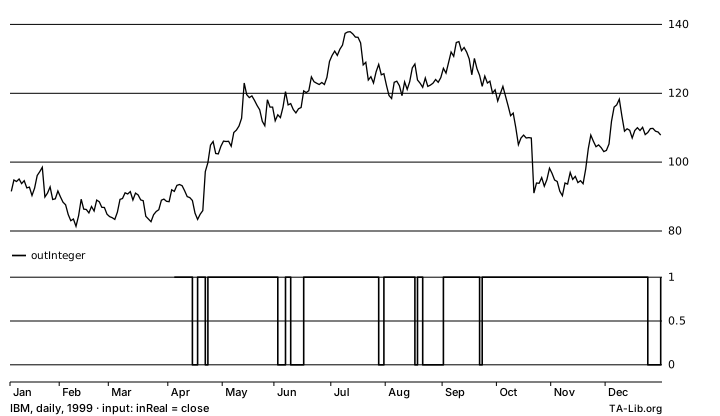
Chart metadata i
Outputs
outInteger:line
Interpretation
Mean-reversion is the trading assumption that price will swing back toward its recent average rather than keep moving in one direction — instead of chasing a breakout, it buys near the low end of the range and sells near the high end, betting on a reversal rather than continuation. A 0 reading is HT_TRENDMODE's signal that this bar fits that regime: price is oscillating rather than trending, so fading the extremes is expected to hold up better than following the move.
Inputs
inReal— Source price series
Outputs
outInteger— 1 = trend mode, 0 = cycle mode
Properties
Numerical Stability: Initial Unstable Period
| ☐ Overlap Input |
| ✅ Independent Y-Axis i |
| ☐ Candlestick |
| ☐ Display Shift |
| ☐ Can Output NaN or ±Inf |
| ☐ Identity at Period 1 |
| ✅ Uses Transcendental i |
| ☐ Input Must Be Positive |
Example
#include <stdio.h>
#include <ta_libc.h>

int n = 252;
double series[252]; /* your data, oldest first */
int out[252];
int outBegIdx, outNBElement;

TA_Initialize();
TA_HT_TRENDMODE( 0, n - 1, series, &outBegIdx, &outNBElement, out );
printf( "%d values from bar %d; last out = %d\n", outNBElement, outBegIdx, out[outNBElement - 1] );use ta_lib::Core;
let series = vec![0.0; 252]; // your data, oldest first
let mut out = vec![0i32; 252];
let core = Core::new();
let range = core.ht_trendmode(0, series.len() - 1, &series, &mut out)?;
println!("{} values from bar {}; last out = {}", range.count, range.beg_idx, out[range.count - 1]);import io.github.talib.Core;
import io.github.talib.OutRange;
double[] series = new double[252]; // your data, oldest first
int[] out = new int[252];
Core core = Core.DEFAULT;
OutRange r = core.htTrendmode(0, series.length - 1, series, out);
System.out.println(r.count() + " values from bar " + r.begIdx() + "; last out = " + out[r.count() - 1]);using System;
using TALib;
var series = new double[252]; // your data, oldest first
var outInteger = new int[252];
var core = Core.Default;
OutRange r = core.HtTrendmode(0, series.Length - 1, series, outInteger);
Console.WriteLine($"{r.Count} values from bar {r.BegIdx}; last outInteger = {outInteger[r.Count - 1]}");import { htTrendmode } from 'ta-lib';
const series = new Float64Array(252); // your data, oldest first
const { begIdx, values } = htTrendmode(series);
console.log(values.length + ' values from bar ' + begIdx + '; last values = ' + values[values.length - 1]);Implementation
Added in 0.4.0.
TA-Lib Definition: ht_trendmode.c · ht_trendmode.yaml
| Native | File |
|---|---|
| C | ta_HT_TRENDMODE.c |
| Rust | ht_trendmode.rs |
| Java | Core_HT_TRENDMODE.java |
| C# | Core_HT_TRENDMODE.cs |
| TypeScript | htTrendmode.ts |
Python: talib.HT_TRENDMODE, see ta-lib-python.
TA-Lib is also available for R and more using a wrapper.
Aliases
Hilbert Transform Trend vs Cycle Mode, Trend Mode
See Also
HT_TRENDLINE · HT_SINE · HT_DCPHASE · HT_DCPERIOD · MAMA
References
- John F. Ehlers, Rocket Science for Traders: Digital Signal Processing Applications, John Wiley & Sons (ISBN 0471405671)