Vertical Horizontal Filter (VHF)
Summary
Vertical Horizontal Filter: Adam White's trend-versus-range filter, the range a window covered divided by the path it actually travelled.
Bounded in [0,1]. Values near 1 mean the market covered most of its path in one direction (trending); values near 0 mean it retraced repeatedly and went nowhere (choppy). Like ADX it measures trend strength, not direction, but it uses no smoothing and carries no recursion.
A common use is regime selection: run trend-following logic while VHF is high, oscillator logic while it is low.
Chart
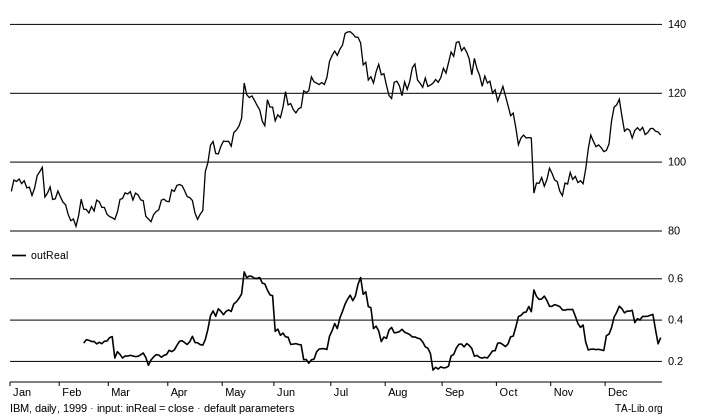
Chart metadata i
Outputs
outReal:line·zero·positive
Formula
num = MAX(C[t-optInTimePeriod+1..t]) - MIN(C[t-optInTimePeriod+1..t]), the range spanned by the optInTimePeriod most recent closes. den = SUM( |C[j] - C[j-1]| ) for j = t-optInTimePeriod+1 .. t, the total absolute movement over the same number of changes, which therefore reaches one close further back. VHF = num / den.
The two windows are deliberately not co-terminal: the extrema span optInTimePeriod closes, the changes consume one more. Because num is the distance between two points the changes connect, num <= den always, so the result never leaves [0,1].
Notes
- A window whose closes are all identical has no vertical movement and no horizontal movement. VHF reports 0 there. Other libraries differ: Tulip Indicators leaves the division unguarded and emits NaN, pandas-ta-classic perturbs the numerator and emits +Inf.
- Adam White later described an 18-bar VHF smoothed by a 6-bar moving average. That variant is not implemented here; apply a moving average to
outRealto obtain it.
Inputs
inReal— Source price/value series, canonically the close
Outputs
outReal— Vertical Horizontal Filter value
Parameters
| Parameter | Type | Default | Accepted values | Description |
|---|---|---|---|---|
optInTimePeriod | integer | 28 | 2–100000 | Number of trailing closes spanned by the range |
Properties
Numerical Stability: Start-Independent
| ☐ Overlap Input |
| ✅ Independent Y-Axis i |
| ☐ Candlestick |
| ☐ Display Shift |
| ☐ Can Output NaN or ±Inf |
| ☐ Identity at Period 1 |
| ☐ Uses Transcendental |
| ☐ Input Must Be Positive |
Example
#include <stdio.h>
#include <ta_libc.h>

int n = 252;
double series[252]; /* your data, oldest first */
double out[252];
int outBegIdx, outNBElement;

TA_Initialize();
TA_VHF( 0, n - 1, series, 28, &outBegIdx, &outNBElement, out );
printf( "%d values from bar %d: [%.4f, ..., %.4f]\n", outNBElement, outBegIdx, out[0], out[outNBElement - 1] );use ta_lib::Core;
let series = vec![0.0; 252]; // your data, oldest first
let mut out = vec![0.0; 252];
let core = Core::new();
let range = core.vhf(0, series.len() - 1, &series, 28, &mut out)?;
println!("{} values from bar {}: [{:.4}, ..., {:.4}]", range.count, range.beg_idx, out[0], out[range.count - 1]);import io.github.talib.Core;
import io.github.talib.OutRange;
import java.util.Locale;
double[] series = new double[252]; // your data, oldest first
double[] out = new double[252];
Core core = Core.DEFAULT;
OutRange r = core.vhf(0, series.length - 1, series, 28, out);
System.out.printf(Locale.ROOT, "%d values from bar %d: [%.4f, ..., %.4f]%n", r.count(), r.begIdx(), out[0], out[r.count() - 1]);using System;
using TALib;
var series = new double[252]; // your data, oldest first
var outReal = new double[252];
var core = Core.Default;
OutRange r = core.Vhf(0, series.Length - 1, series, 28, outReal);
Console.WriteLine(FormattableString.Invariant($"{r.Count} values from bar {r.BegIdx}: [{outReal[0]:F4}, ..., {outReal[r.Count - 1]:F4}]"));import { vhf } from 'ta-lib';
const series = new Float64Array(252); // your data, oldest first
const { begIdx, values } = vhf(series, { timePeriod: 28 });
console.log(values.length + ' values from bar ' + begIdx + ': [' + values[0].toFixed(4) + ', ..., ' + values[values.length - 1].toFixed(4) + ']');import (
"fmt"
"log"
talib "ta-lib.github.io/go"
)
series := make([]float64, 252) // your data, oldest first
out := make([]float64, 252)
core := talib.NewCore()
r, err := core.VHF(0, len(series)-1, series, 28, out)
if err != nil {
log.Fatal(err)
}
fmt.Printf("%d values from bar %d: [%.4f, ..., %.4f]\n", r.NBElement, r.BegIdx, out[0], out[r.NBElement-1])Implementation
Added in 0.8.1 (ta-lib-python 0.8.1).
TA-Lib Definition: vhf.c · vhf.yaml
| Native | File |
|---|---|
| C | ta_VHF.c |
| Rust | vhf.rs |
| Java | Core_VHF.java |
| C# | Core_VHF.cs |
| TypeScript | vhf.ts |
| Go | vhf.go |
Python: talib.VHF (ta-lib-python 0.8.1 or later), see ta-lib-python.
TA-Lib is also available for R and more using a wrapper.
Aliases
Vertical Horizontal Filter
See Also
References
- Adam White, "The Vertical Horizontal Filter", Futures Magazine, August 1991
- Steven B. Achelis, Technical Analysis from A to Z, McGraw-Hill (p. 354)
- Incredible Charts: Vertical Horizontal Filter