Squeeze Momentum and Level (SQZMOM)
Summary
John Carter's TTM Squeeze, in the form LazyBear published on TradingView in 2014. Volatility compression is read by comparing the Bollinger Bands against a Keltner Channel: when the bands sit inside the channel the market is coiled, and when they push outside it the coil has released. LazyBear replaced Carter's simple momentum with a linear regression of the close against a Donchian/SMA anchor, which is the histogram that StockCharts, ta4j and trading-signals compute, and pandas-ta with lazybear=True.
"Squeeze Pro" tests the bands against three Keltner widths instead of one, so compression becomes a level rather than a boolean. outSqueeze carries that level: 3, 2 and 1 for the narrow, normal and wide channels, -1 once the bands are outside the wide channel, and 0 in between. The classic squeeze-on flag is outSqueeze >= 2, and with wide == normal the three states are exactly LazyBear's on / off / none.
Chart
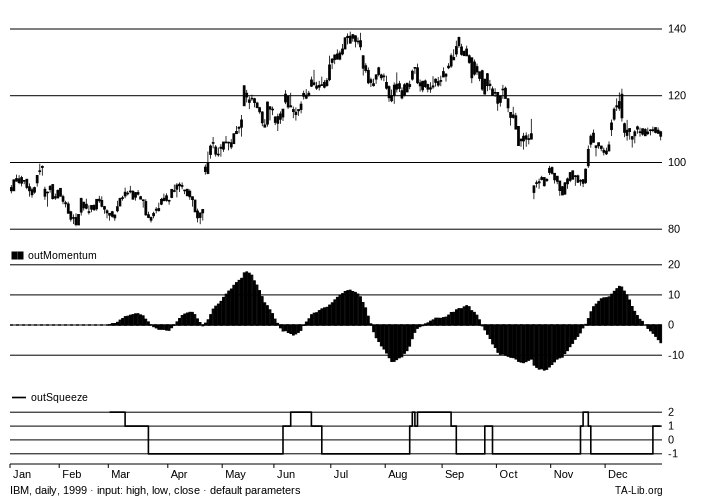
Chart metadata i
Outputs
outMomentum:histogram·zero·positive·negativeoutSqueeze:line
Formula
With b = optInBBPeriod and k = optInKCPeriod:
BBU, BBL = SMA(close, b) +/- optInNbDev * STDDEV(close, b)
KCM      = SMA(close, k)
BAND     = SMA(TRANGE(high, low, close), k)
DMID     = MIDPRICE(high, low, k)
DEV      = close - ( DMID + KCM ) / 2

outMomentum = LINEARREG(DEV, k)

inside(m)  = BBL > KCM - m*BAND  and  BBU < KCM + m*BAND

outSqueeze =  3  if inside(optInFactorNarrow)
              2  if inside(optInFactorNormal)
              1  if inside(optInFactorWide)
             -1  if BBL < KCM - optInFactorWide*BAND and BBU > KCM + optInFactorWide*BAND
              0  otherwise
Notes
BANDis the simple mean of the true range overkbars, not an ATR: no Wilder smoothing, and so no unstable period anywhere in this function.- The anchor is written three ways across the sources —
avg(avg(HH,LL), SMA),((HH+LL)/2 + SMA)/2and0.25*(HH+LL) + 0.5*SMA. All three give the same double, because scaling by a power of two is exact. - The three channels share a centre and
BAND >= 0, so they nest: inside the narrow one implies inside the normal one implies inside the wide one. The ordinal is therefore monotone, and the factors are required only to be orderedwide >= normal >= narrow >= 0, not strictly. Factors out of that order are rejected withTA_BAD_PARAM. - The momentum window is the Keltner period, as in LazyBear's script, pandas and trading-signals.
- The three chains that feed the outputs do not reach their first value together. The first output bar is the latest of them, so where
bis much larger thankthe momentum exists before the state does and is still withheld until both do. pandas emits the earlier momentum; a capture compared against it must start at the later bar.
Inputs
inHigh— High price of each barinLow— Low price of each barinClose— Closing price of each bar
Outputs
outMomentum— Linear regression of the close against the Donchian/SMA anchoroutSqueeze— Compression level: 3 narrow, 2 normal, 1 wide, -1 released, 0 otherwise
Parameters
| Parameter | Type | Default | Accepted values | Description |
|---|---|---|---|---|
optInBBPeriod | integer | 20 | 2–100000 | Number of bars in the Bollinger Band window |
optInNbDev | real | 2 | ≥ 0 | Number of standard deviations the Bollinger Bands are placed at |
optInKCPeriod | integer | 20 | 2–100000 | Number of bars in the Keltner Channel, the true-range mean and the regression |
optInFactorWide | real | 2 | ≥ 0 | Keltner width, in true-range means, of the widest channel |
optInFactorNormal | real | 1.5 | ≥ 0 | Keltner width of the classic channel |
optInFactorNarrow | real | 1 | ≥ 0 | Keltner width of the tightest channel |
Properties
Numerical Stability: Start-Independent
| ☐ Overlap Input |
| ✅ Independent Y-Axis i |
| ☐ Candlestick |
| ☐ Display Shift |
| ☐ Can Output NaN or ±Inf |
| ☐ Identity at Period 1 |
| ☐ Uses Transcendental |
| ☐ Input Must Be Positive |
Example
#include <stdio.h>
#include <ta_libc.h>

int n = 252;
double high[252]; /* your data, oldest first */
double low[252]; /* your data, oldest first */
double close[252]; /* your data, oldest first */
double momentum[252];
int squeeze[252];
int outBegIdx, outNBElement;

TA_Initialize();
TA_SQZMOM( 0, n - 1, high, low, close, 20, 2.0, 20, 2.0, 1.5, 1.0,
           &outBegIdx, &outNBElement, momentum, squeeze );
printf( "%d values from bar %d; last momentum = %f\n", outNBElement, outBegIdx, momentum[outNBElement - 1] );use ta_lib::Core;
let high = vec![0.0; 252]; // your data, oldest first
let low = vec![0.0; 252]; // your data, oldest first
let close = vec![0.0; 252]; // your data, oldest first
let mut momentum = vec![0.0; 252];
let mut squeeze = vec![0i32; 252];
let core = Core::new();
let range = core.sqzmom(0, high.len() - 1, &high, &low, &close, 20, 2.0, 20, 2.0, 1.5, 1.0,
&mut momentum, &mut squeeze)?;
println!("{} values from bar {}; last momentum = {}", range.count, range.beg_idx, momentum[range.count - 1]);import io.github.talib.Core;
import io.github.talib.OutRange;
double[] high = new double[252]; // your data, oldest first
double[] low = new double[252]; // your data, oldest first
double[] close = new double[252]; // your data, oldest first
double[] momentum = new double[252];
int[] squeeze = new int[252];
Core core = Core.DEFAULT;
OutRange r = core.sqzmom(0, high.length - 1, high, low, close, 20, 2.0, 20, 2.0, 1.5, 1.0,
momentum, squeeze);
System.out.println(r.count() + " values from bar " + r.begIdx() + "; last momentum = " + momentum[r.count() - 1]);using System;
using TALib;
var high = new double[252]; // your data, oldest first
var low = new double[252]; // your data, oldest first
var close = new double[252]; // your data, oldest first
var momentum = new double[252];
var squeeze = new int[252];
var core = Core.Default;
OutRange r = core.Sqzmom(0, high.Length - 1, high, low, close, 20, 2.0, 20, 2.0, 1.5, 1.0,
momentum, squeeze);
Console.WriteLine($"{r.Count} values from bar {r.BegIdx}; last momentum = {momentum[r.Count - 1]}");import { sqzmom } from 'ta-lib';
const high = new Float64Array(252); // your data, oldest first
const low = new Float64Array(252); // your data, oldest first
const close = new Float64Array(252); // your data, oldest first
const { begIdx, outMomentum, outSqueeze } = sqzmom({ high, low, close }, {
bbPeriod: 20,
nbDev: 2,
kcPeriod: 20,
factorWide: 2,
factorNormal: 1.5,
factorNarrow: 1,
});
console.log(outMomentum.length + ' values from bar ' + begIdx + '; last outMomentum = ' + outMomentum[outMomentum.length - 1]);Implementation
Added in 0.8.3 (ta-lib-python 0.8.3).
TA-Lib Definition: sqzmom.c · sqzmom.yaml
| Native | File |
|---|---|
| C | ta_SQZMOM.c |
| Rust | sqzmom.rs |
| Java | Core_SQZMOM.java |
| C# | Core_SQZMOM.cs |
| TypeScript | sqzmom.ts |
Python: talib.SQZMOM (ta-lib-python 0.8.3 or later), see ta-lib-python.
TA-Lib is also available for R and more using a wrapper.
Aliases
Squeeze Momentum, TTM Squeeze, TTM Squeeze Pro, SQZMOM_LB
See Also
BBANDS · KC · TRANGE · MIDPRICE · LINEARREG
References
- John F. Carter, Mastering the Trade, McGraw-Hill, 2005, chapter 11
- LazyBear, "Squeeze Momentum Indicator [LazyBear]", TradingView, 2014-07-04
- Beardy_Fred, "TTM Squeeze Pro", TradingView, 2021