Money Flow Index (MFI)
Summary
Money Flow Index: a volume-weighted momentum oscillator (0-100) comparing positive vs negative money flow over a period. A volume-based analog of RSI. >80 overbought, <20 oversold.
Chart
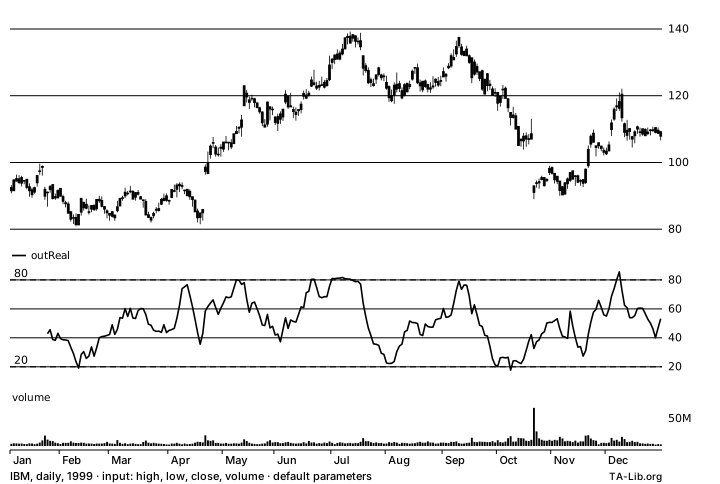
Chart metadata i
Outputs
outReal:line·zero·positive·levels: 20, 80
Formula
TP = (High+Low+Close)/3; MF = TP*Volume, classed positive if TP>prevTP, negative if TP<prevTP, neither if equal. MFI = 100 * posSumMF/(posSumMF+negSumMF).
Notes
- When the typical price is unchanged from the prior bar, that bar's money flow is counted as neither positive nor negative.
- A window in which no bar contributed any money flow — every typical price unchanged, or no volume traded — leaves the index undefined (0/0); 0 is returned. The result does not otherwise depend on the size of the money flow: scaling every volume, or quoting the instrument in a different unit, leaves the index unchanged.
Inputs
inHigh— High price of each barinLow— Low price of each barinClose— Close price of each barinVolume— Volume of each bar
Outputs
outReal— Money Flow Index
Parameters
| Parameter | Type | Default | Accepted values | Description |
|---|---|---|---|---|
optInTimePeriod | integer | 14 | 2–100000 | Lookback window for summing money flow |
Properties
Numerical Stability: Start-Independent
| ☐ Overlap Input |
| ✅ Independent Y-Axis i |
| ☐ Candlestick |
| ☐ Display Shift |
| ☐ Can Output NaN or ±Inf |
| ☐ Identity at Period 1 |
| ☐ Uses Transcendental |
| ☐ Input Must Be Positive |
Example
C
#include <stdio.h>
#include <ta_libc.h>

int n = 252;
double high[252]; /* your data, oldest first */
double low[252]; /* your data, oldest first */
double close[252]; /* your data, oldest first */
double volume[252]; /* your data, oldest first */
double out[252];
int outBegIdx, outNBElement;

TA_Initialize();
TA_MFI( 0, n - 1, high, low, close, volume, 14, &outBegIdx, &outNBElement, out );
printf( "%d values from bar %d; last out = %f\n", outNBElement, outBegIdx, out[outNBElement - 1] );
Rust
use ta_lib::Core;

let high = vec![0.0; 252]; // your data, oldest first
let low = vec![0.0; 252]; // your data, oldest first
let close = vec![0.0; 252]; // your data, oldest first
let volume = vec![0.0; 252]; // your data, oldest first
let mut out = vec![0.0; 252];

let core = Core::new();
let range = core.mfi(0, high.len() - 1, &high, &low, &close, &volume, 14, &mut out)?;
println!("{} values from bar {}; last out = {}", range.count, range.beg_idx, out[range.count - 1]);
Java
import io.github.talib.Core;
import io.github.talib.OutRange;

double[] high = new double[252]; // your data, oldest first
double[] low = new double[252]; // your data, oldest first
double[] close = new double[252]; // your data, oldest first
double[] volume = new double[252]; // your data, oldest first
double[] out = new double[252];

Core core = Core.DEFAULT;
OutRange r = core.mfi(0, high.length - 1, high, low, close, volume, 14, out);
System.out.println(r.count() + " values from bar " + r.begIdx() + "; last out = " + out[r.count() - 1]);
C#
using System;
using TALib;

var high = new double[252]; // your data, oldest first
var low = new double[252]; // your data, oldest first
var close = new double[252]; // your data, oldest first
var volume = new double[252]; // your data, oldest first
var outReal = new double[252];

var core = Core.Default;
OutRange r = core.Mfi(0, high.Length - 1, high, low, close, volume, 14, outReal);
Console.WriteLine($"{r.Count} values from bar {r.BegIdx}; last outReal = {outReal[r.Count - 1]}");
TypeScript
import { mfi } from 'ta-lib';

const high = new Float64Array(252); // your data, oldest first
const low = new Float64Array(252); // your data, oldest first
const close = new Float64Array(252); // your data, oldest first
const volume = new Float64Array(252); // your data, oldest first

const { begIdx, values } = mfi({ high, low, close, volume }, {
  timePeriod: 14,
});
console.log(values.length + ' values from bar ' + begIdx + '; last values = ' + values[values.length - 1]);
Implementation
Added in 0.4.0.
TA-Lib Definition: mfi.c · mfi.yaml
| Native | File |
|---|---|
| C | ta_MFI.c |
| Rust | mfi.rs |
| Java | Core_MFI.java |
| C# | Core_MFI.cs |
| TypeScript | mfi.ts |
Python: talib.MFI, see ta-lib-python.
TA-Lib is also available for R and more using a wrapper.
Aliases
Money Flow Index
See Also
References
- Gene Quong & Avrum Soudack, Volume-Weighted RSI: Money Flow, Technical Analysis of Stocks & Commodities, V.7:3 (March 1989)