Directional Movement Index (DX)
Summary
Wilder's Directional Movement Index: the normalized spread between +DI and -DI. Measures the strength of directional (trending) movement, irrespective of direction. Higher DX = stronger trend (either direction); low DX = ranging market.
Chart
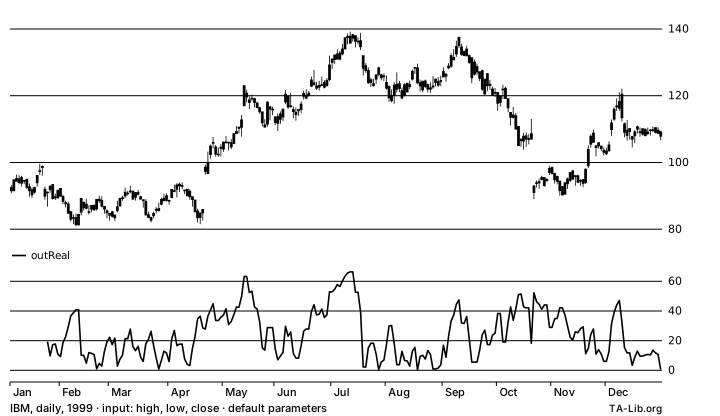
Chart metadata i
Outputs
outReal:line·zero·positive
Formula
Seed +DM14, -DM14, TR14 as sums of the first (period-1) one-period values, then Wilder-smooth each: X = X - X/period + today. +DI = 100*(+DM14/TR14), -DI = 100*(-DM14/TR14). DX = 100 * |(-DI) - (+DI)| / ((-DI) + (+DI)).
Notes
- Wilder's original integer rounding is not applied (it can be unreliable when values are near 1).
- When +DI and -DI sum to zero the value is undefined; the previous bar's DX is carried forward instead (the first such bar outputs zero).
Inputs
inHigh— High price of each barinLow— Low price of each barinClose— Close price of each bar
Outputs
outReal— DX directional movement index value
Parameters
| Parameter | Type | Default | Accepted values | Description |
|---|---|---|---|---|
optInTimePeriod | integer | 14 | 2–100000 | Smoothing period for the DM and TR sums |
Properties
Numerical Stability: Initial Unstable Period
| ☐ Overlap Input |
| ✅ Independent Y-Axis i |
| ☐ Candlestick |
| ☐ Display Shift |
| ☐ Can Output NaN or ±Inf |
| ☐ Identity at Period 1 |
| ☐ Uses Transcendental |
| ☐ Input Must Be Positive |
Example
C
#include <stdio.h>
#include <ta_libc.h>

int n = 252;
double high[252]; /* your data, oldest first */
double low[252]; /* your data, oldest first */
double close[252]; /* your data, oldest first */
double out[252];
int outBegIdx, outNBElement;

TA_Initialize();
TA_DX( 0, n - 1, high, low, close, 14, &outBegIdx, &outNBElement, out );
printf( "%d values from bar %d; last out = %f\n", outNBElement, outBegIdx, out[outNBElement - 1] );
Rust
use ta_lib::Core;

let high = vec![0.0; 252]; // your data, oldest first
let low = vec![0.0; 252]; // your data, oldest first
let close = vec![0.0; 252]; // your data, oldest first
let mut out = vec![0.0; 252];

let core = Core::new();
let range = core.dx(0, high.len() - 1, &high, &low, &close, 14, &mut out)?;
println!("{} values from bar {}; last out = {}", range.count, range.beg_idx, out[range.count - 1]);
Java
import io.github.talib.Core;
import io.github.talib.OutRange;

double[] high = new double[252]; // your data, oldest first
double[] low = new double[252]; // your data, oldest first
double[] close = new double[252]; // your data, oldest first
double[] out = new double[252];

Core core = Core.DEFAULT;
OutRange r = core.dx(0, high.length - 1, high, low, close, 14, out);
System.out.println(r.count() + " values from bar " + r.begIdx() + "; last out = " + out[r.count() - 1]);
C#
using System;
using TALib;

var high = new double[252]; // your data, oldest first
var low = new double[252]; // your data, oldest first
var close = new double[252]; // your data, oldest first
var outReal = new double[252];

var core = Core.Default;
OutRange r = core.Dx(0, high.Length - 1, high, low, close, 14, outReal);
Console.WriteLine($"{r.Count} values from bar {r.BegIdx}; last outReal = {outReal[r.Count - 1]}");
TypeScript
import { dx } from 'ta-lib';

const high = new Float64Array(252); // your data, oldest first
const low = new Float64Array(252); // your data, oldest first
const close = new Float64Array(252); // your data, oldest first

const { begIdx, values } = dx({ high, low, close }, { timePeriod: 14 });
console.log(values.length + ' values from bar ' + begIdx + '; last values = ' + values[values.length - 1]);
Implementation
Added in 0.4.0.
TA-Lib Definition: dx.c · dx.yaml
| Native | File |
|---|---|
| C | ta_DX.c |
| Rust | dx.rs |
| Java | Core_DX.java |
| C# | Core_DX.cs |
| TypeScript | dx.ts |
Python: talib.DX, see ta-lib-python.
TA-Lib is also available for R and more using a wrapper.
Aliases
Directional Movement Index, DMI
See Also
ADX · ADXR · PLUS_DI · MINUS_DI · PLUS_DM · MINUS_DM · TRANGE
References
- J. Welles Wilder, New Concepts in Technical Trading Systems, Trend Research (ISBN 0894590278)