Up/Down-gap side-by-side white lines (CDLGAPSIDESIDEWHITE)
Summary
A three-candle pattern: a first candle followed by two white candles of similar body size that both gap the same direction (up or down) from the first candle's real body and open at about the same level. It is a continuation signal whose sign reports the gap direction; the code does not verify a prior trend.
Chart
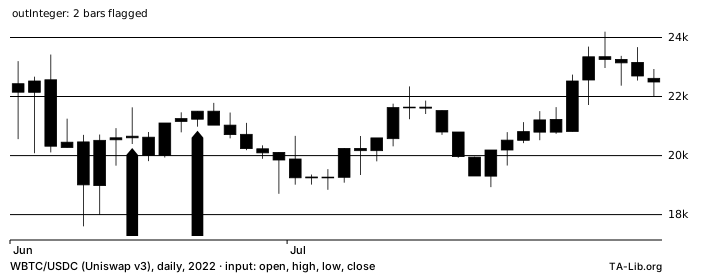
Chart metadata i
Outputs
outInteger:pattern_bull_bear·zero·positive·negative
Notes
- Does not verify the prior trend the continuation signal classically assumes.
- Bulkowski's data shows the bullish form continues as labeled 66% of the time; the bearish form's 56% continuation rate is "near random", and Bulkowski cautions the bearish sample is too thin to trust. (thepatternsite.com)
- Rare in Bulkowski's tests: he ranks the bullish form 73rd and the bearish 86th of 103 patterns by how often they occur (bullish, bearish). It fires more often in crypto: 18 times in about 16,000 daily bars.
Inputs
inOpen— Open price of each barinHigh— High price of each barinLow— Low price of each barinClose— Close price of each bar
Outputs
outInteger— +100 for an up-gap (bullish continuation), -100 for a down-gap (bearish continuation), 0 when no pattern. Sign is set solely by the C2-vs-C1 gap direction (realbodygapup ? 100 : -100)
Output Values
What candlestick values mean: Candlestick Outputs. The function's flags declare which values it can return: rW7.
| Value | Meaning |
|---|---|
| -100 | Bearish continuation: two similar white candles gapped down together and held the gap, suggesting the decline will resume |
| 0 | No pattern |
| 100 | Bullish continuation: two similar white candles gapped up together and held the gap, suggesting the advance will resume |
Properties
Numerical Stability: Start-Independent
| ☐ Overlap Input |
| ✅ Independent Y-Axis i |
| ✅ Candlestick i |
| ☐ Display Shift |
| ☐ Can Output NaN or ±Inf |
| ☐ Identity at Period 1 |
| ☐ Uses Transcendental |
| ☐ Input Must Be Positive |
Example
C
#include <stdio.h>
#include <ta_libc.h>

int n = 252;
double open[252]; /* your data, oldest first */
double high[252]; /* your data, oldest first */
double low[252]; /* your data, oldest first */
double close[252]; /* your data, oldest first */
int out[252];
int outBegIdx, outNBElement;

TA_Initialize();
TA_CDLGAPSIDESIDEWHITE( 0, n - 1, open, high, low, close, &outBegIdx, &outNBElement, out );
printf( "%d values from bar %d; last out = %d\n", outNBElement, outBegIdx, out[outNBElement - 1] );
Rust
use ta_lib::Core;

let open = vec![0.0; 252]; // your data, oldest first
let high = vec![0.0; 252]; // your data, oldest first
let low = vec![0.0; 252]; // your data, oldest first
let close = vec![0.0; 252]; // your data, oldest first
let mut out = vec![0i32; 252];

let core = Core::new();
let range = core.cdlgapsidesidewhite(0, open.len() - 1, &open, &high, &low, &close,
                                     &mut out)?;
println!("{} values from bar {}; last out = {}", range.count, range.beg_idx, out[range.count - 1]);
Java
import io.github.talib.Core;
import io.github.talib.OutRange;

double[] open = new double[252]; // your data, oldest first
double[] high = new double[252]; // your data, oldest first
double[] low = new double[252]; // your data, oldest first
double[] close = new double[252]; // your data, oldest first
int[] out = new int[252];

Core core = Core.DEFAULT;
OutRange r = core.cdlgapsidesidewhite(0, open.length - 1, open, high, low, close, out);
System.out.println(r.count() + " values from bar " + r.begIdx() + "; last out = " + out[r.count() - 1]);
C#
using System;
using TALib;

var open = new double[252]; // your data, oldest first
var high = new double[252]; // your data, oldest first
var low = new double[252]; // your data, oldest first
var close = new double[252]; // your data, oldest first
var outInteger = new int[252];

var core = Core.Default;
OutRange r = core.Cdlgapsidesidewhite(0, open.Length - 1, open, high, low, close, outInteger);
Console.WriteLine($"{r.Count} values from bar {r.BegIdx}; last outInteger = {outInteger[r.Count - 1]}");
TypeScript
import { cdlgapsidesidewhite } from 'ta-lib';

const open = new Float64Array(252); // your data, oldest first
const high = new Float64Array(252); // your data, oldest first
const low = new Float64Array(252); // your data, oldest first
const close = new Float64Array(252); // your data, oldest first

const { begIdx, values } = cdlgapsidesidewhite({ open, high, low, close });
console.log(values.length + ' values from bar ' + begIdx + '; last values = ' + values[values.length - 1]);
Implementation
Added in 0.4.0.
TA-Lib Definition: cdlgapsidesidewhite.c · cdlgapsidesidewhite.yaml
| Native | File |
|---|---|
| C | ta_CDLGAPSIDESIDEWHITE.c |
| Rust | cdlgapsidesidewhite.rs |
| Java | Core_CDLGAPSIDESIDEWHITE.java |
| C# | Core_CDLGAPSIDESIDEWHITE.cs |
| TypeScript | cdlgapsidesidewhite.ts |
Python: talib.CDLGAPSIDESIDEWHITE, see ta-lib-python.
TA-Lib is also available for R and more using a wrapper.
Aliases
Up/Down-gap side-by-side white lines, Gapping side-by-side white lines