Swiss Army Knife - Two-Pole High-Pass Filter (SWAK_2PHP)
Summary
The two-pole high-pass row of John Ehlers' Swiss Army Knife filter: the same double real pole the Gaussian and Butterworth rows use, with a detrending numerator instead of a smoothing one. It removes what is slower than the cutoff period and rolls off twice as steeply as the one-pole row.
Read it as an oscillator, not as price. Its DC gain is 0, so a flat market returns zero and a trend returns its departure from itself. Against TA_SWAK_HP the difference is the slope of the transition: the second pole buys a sharper separation between what is kept and what is removed.
Chart
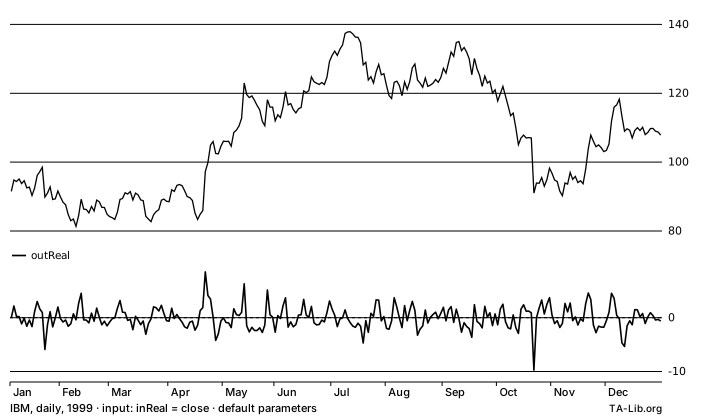
Chart metadata i
Outputs
outReal:line·zero·positive·negative
Formula
w   = 2 * pi / optInTimePeriod
b2p = 2.415 * (1 - cos(w))
a2p = -b2p + sqrt(b2p^2 + 2 * b2p)

c0  = (1 - a2p / 2)^2
a1  = 2 * (1 - a2p)
a2  = -(1 - a2p)^2

y[i] = c0 * (x[i] - 2 * x[i-1] + x[i-2]) + a1 * y[i-1] + a2 * y[i-2]
The numerator is zero on a constant, which is what makes the DC gain 0. At Nyquist it weighs 4, and c0 divides that back to exactly 1.
The filter is seeded in the steady state of a constant input equal to its first bar: both input slots start at that bar and both output slots at zero.
Notes
Every term of the recurrence exists at the first bar, so there is no structural lookback. What the first bars carry is the seed, which decays rather than ending: set TA_FUNC_UNST_SWAK_2PHP to discard bars until that transient is below whatever matters for the caller. The pole is a repeated real root, so the transient decays as k * (1 - a2p)^k rather than as a plain geometric.
The output may alias the input. This row reads x[i-1] and x[i-2], which an aliased write would already have overwritten, so both are carried in locals and never re-read from the input array.
Inputs
inReal— The series to detrend; Ehlers' default is the bar midpoint(H+L)/2, which the caller passes asTA_MEDPRICEoutput
Outputs
outReal— The detrended line, centred on zero
Parameters
| Parameter | Type | Default | Accepted values | Description |
|---|---|---|---|---|
optInTimePeriod | integer | 20 | 2–10000 | Cutoff period; cycles longer than it are removed, cycles shorter pass |
Properties
Numerical Stability: Initial Unstable Period
| ☐ Overlap Input |
| ✅ Independent Y-Axis i |
| ☐ Candlestick |
| ☐ Display Shift |
| ☐ Can Output NaN or ±Inf |
| ☐ Identity at Period 1 |
| ✅ Uses Transcendental i |
| ☐ Input Must Be Positive |
Example
#include <stdio.h>
#include <ta_libc.h>

int n = 252;
double series[252]; /* your data, oldest first */
double out[252];
int outBegIdx, outNBElement;

TA_Initialize();
TA_SWAK_2PHP( 0, n - 1, series, 20, &outBegIdx, &outNBElement, out );
printf( "%d values from bar %d; last out = %f\n", outNBElement, outBegIdx, out[outNBElement - 1] );use ta_lib::Core;
let series = vec![0.0; 252]; // your data, oldest first
let mut out = vec![0.0; 252];
let core = Core::new();
let range = core.swak_2php(0, series.len() - 1, &series, 20, &mut out)?;
println!("{} values from bar {}; last out = {}", range.count, range.beg_idx, out[range.count - 1]);import io.github.talib.Core;
import io.github.talib.OutRange;
double[] series = new double[252]; // your data, oldest first
double[] out = new double[252];
Core core = Core.DEFAULT;
OutRange r = core.swak2php(0, series.length - 1, series, 20, out);
System.out.println(r.count() + " values from bar " + r.begIdx() + "; last out = " + out[r.count() - 1]);using System;
using TALib;
var series = new double[252]; // your data, oldest first
var outReal = new double[252];
var core = Core.Default;
OutRange r = core.Swak2php(0, series.Length - 1, series, 20, outReal);
Console.WriteLine($"{r.Count} values from bar {r.BegIdx}; last outReal = {outReal[r.Count - 1]}");import { swak2php } from 'ta-lib';
const series = new Float64Array(252); // your data, oldest first
const { begIdx, values } = swak2php(series, { timePeriod: 20 });
console.log(values.length + ' values from bar ' + begIdx + '; last values = ' + values[values.length - 1]);import (
"fmt"
"log"
talib "ta-lib.github.io/go"
)
series := make([]float64, 252) // your data, oldest first
out := make([]float64, 252)
core := talib.NewCore()
r, err := core.SWAK_2PHP(0, len(series)-1, series, 20, out)
if err != nil {
log.Fatal(err)
}
fmt.Printf("%d values from bar %d; last out = %.4f\n", r.NBElement, r.BegIdx, out[r.NBElement-1])Implementation
Added in 0.8.3 (ta-lib-python 0.8.3).
TA-Lib Definition: swak_2php.c · swak_2php.yaml
| Native | File |
|---|---|
| C | ta_SWAK_2PHP.c |
| Rust | swak_2php.rs |
| Java | Core_SWAK_2PHP.java |
| C# | Core_SWAK_2PHP.cs |
| TypeScript | swak2php.ts |
| Go | swak_2php.go |
Python: talib.SWAK_2PHP (ta-lib-python 0.8.3 or later), see ta-lib-python.
TA-Lib is also available for R and more using a wrapper.
Aliases
Swiss Army Knife Two-Pole High-Pass Filter, SWAK 2PHP, Ehlers Two-Pole High-Pass Filter
See Also
References
- Ehlers, John F. "Swiss Army Knife Indicator." Technical Analysis of Stocks & Commodities V.24:1 (January 2006), pp. 28-31, 50-53.