Standard Deviation (STDDEV)
Summary
Rolling standard deviation of a series over a window, scaled by a deviations multiplier. Delegates to VAR, then takes the square root.
Chart
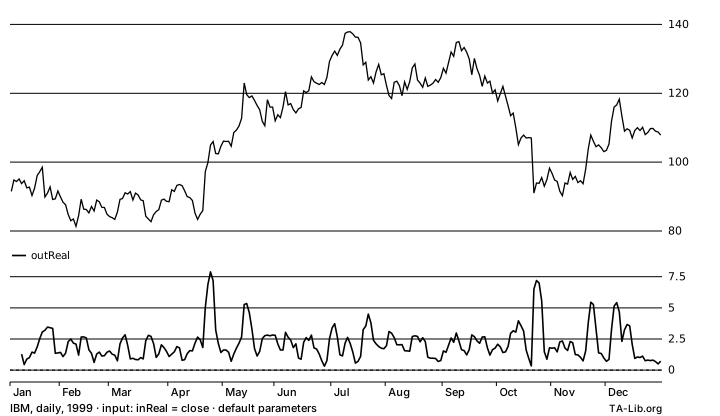
Chart metadata i
Outputs
outReal:line·zero·positive·negative
Formula
, where (population variance, timePeriod)
Notes
- Uses population variance (divides by the period, not period minus one), so results differ slightly from the sample standard deviation used by some tools.
Inputs
inReal— Series to measure dispersion of
Outputs
outReal— Standard deviation at each bar, scaled by optInNbDev
Parameters
| Parameter | Type | Default | Accepted values | Description |
|---|---|---|---|---|
optInTimePeriod | integer | 5 | 2–100000 | Window length |
optInNbDev | real | 1 | any real | Multiplier applied to the standard deviation |
Properties
Numerical Stability: Start-Independent
| ☐ Overlap Input |
| ✅ Independent Y-Axis i |
| ☐ Candlestick |
| ☐ Display Shift |
| ☐ Can Output NaN or ±Inf |
| ☐ Identity at Period 1 |
| ☐ Uses Transcendental |
| ☐ Input Must Be Positive |
Example
C
#include <stdio.h>
#include <ta_libc.h>

int n = 252;
double series[252]; /* your data, oldest first */
double out[252];
int outBegIdx, outNBElement;

TA_Initialize();
TA_STDDEV( 0, n - 1, series, 5, 1.0, &outBegIdx, &outNBElement, out );
printf( "%d values from bar %d; last out = %f\n", outNBElement, outBegIdx, out[outNBElement - 1] );
Rust
use ta_lib::Core;

let series = vec![0.0; 252]; // your data, oldest first
let mut out = vec![0.0; 252];

let core = Core::new();
let range = core.stddev(0, series.len() - 1, &series, 5, 1.0, &mut out)?;
println!("{} values from bar {}; last out = {}", range.count, range.beg_idx, out[range.count - 1]);
Java
import io.github.talib.Core;
import io.github.talib.OutRange;

double[] series = new double[252]; // your data, oldest first
double[] out = new double[252];

Core core = Core.DEFAULT;
OutRange r = core.stddev(0, series.length - 1, series, 5, 1.0, out);
System.out.println(r.count() + " values from bar " + r.begIdx() + "; last out = " + out[r.count() - 1]);
C#
using System;
using TALib;

var series = new double[252]; // your data, oldest first
var outReal = new double[252];

var core = Core.Default;
OutRange r = core.Stddev(0, series.Length - 1, series, 5, 1.0, outReal);
Console.WriteLine($"{r.Count} values from bar {r.BegIdx}; last outReal = {outReal[r.Count - 1]}");
TypeScript
import { stddev } from 'ta-lib';

const series = new Float64Array(252); // your data, oldest first

const { begIdx, values } = stddev(series, { timePeriod: 5, nbDev: 1 });
console.log(values.length + ' values from bar ' + begIdx + '; last values = ' + values[values.length - 1]);
Implementation
Added in 0.4.0.
TA-Lib Definition: stddev.c · stddev.yaml
| Native | File |
|---|---|
| C | ta_STDDEV.c |
| Rust | stddev.rs |
| Java | Core_STDDEV.java |
| C# | Core_STDDEV.cs |
| TypeScript | stddev.ts |
Python: talib.STDDEV, see ta-lib-python.
TA-Lib is also available for R and more using a wrapper.
Aliases
Standard Deviation, SD, sigma