Ehlers SuperSmoother Filter (SSF)
Summary
John Ehlers' SuperSmoother: a two-pole low-pass smoother with a zero at Nyquist, which he recommends for use instead of an EMA and builds most of his later indicators on. Read it as a smoothed price line with less lag than an EMA of comparable smoothness.
Its DC gain is 1, so a flat market returns the price itself and the line sits on the chart with price. The critical period is the wavelength that divides the pass band from the reject band: cycles longer than it pass, shorter ones fall off at 12 dB per octave, and a two-bar alternation is removed entirely. The poles are a complex pair, which no EMA of an EMA and none of the SWAK_* rows can place.
Chart
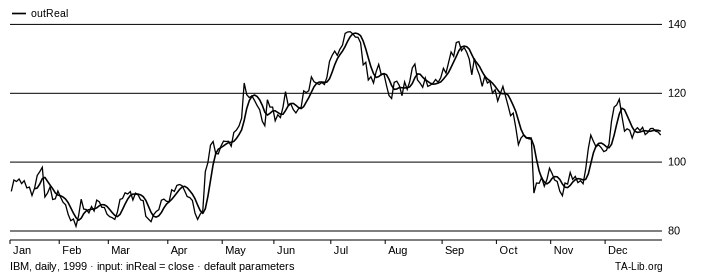
Chart metadata i
Outputs
outReal:line
Formula
P  = optInTimePeriod
a1 = exp(-1.414 * 3.14159 / P)
c2 = 2 * a1 * cos(1.414 * pi / P)
c3 = -a1^2
c1 = 1 - c2 - c3

y[i] = c1 * (x[i] + x[i-1]) / 2 + c2 * y[i-1] + c3 * y[i-2]
The constants are Ehlers' own: 1.414 and 3.14159 in the radius, and a cosine he takes in degrees as cos(1.414 * 180 / P). The first three bars of the history seed the filter with the price; the first output is a recursion step, at bar max(P - 1, 3).
Notes
- A period of 1 performs no smoothing: the output is a copy of the input, consistent with
MA(period=1)for every MAType. - Ehlers' 2004 form averages no bars in the numerator (
c1 * x[i], no zero at Nyquist); he replaced it by 2013, and implementations still computing it differ from this function by up to a few percent. - Implementations with an exact
sqrt(2)andpiin place of Ehlers' constants differ from this function in about the fifth significant digit.
Inputs
inReal— The series to smooth; Ehlers' examples use the close
Outputs
outReal— The smoothed line, on the same scale as the input
Parameters
| Parameter | Type | Default | Accepted values | Description |
|---|---|---|---|---|
optInTimePeriod | integer | 10 | 1–10000 | Critical period: the wavelength that divides the pass band and the reject band |
Properties
Numerical Stability: Initial Unstable Period
| ✅ Overlap Input i |
| ☐ Independent Y-Axis |
| ☐ Candlestick |
| ☐ Display Shift |
| ☐ Can Output NaN or ±Inf |
| ✅ Identity at Period 1 i |
| ✅ Uses Transcendental i |
| ☐ Input Must Be Positive |
Example
#include <stdio.h>
#include <ta_libc.h>

int n = 252;
double series[252]; /* your data, oldest first */
double out[252];
int outBegIdx, outNBElement;

TA_Initialize();
TA_SSF( 0, n - 1, series, 10, &outBegIdx, &outNBElement, out );
printf( "%d values from bar %d: [%.4f, ..., %.4f]\n", outNBElement, outBegIdx, out[0], out[outNBElement - 1] );use ta_lib::Core;
let series = vec![0.0; 252]; // your data, oldest first
let mut out = vec![0.0; 252];
let core = Core::new();
let range = core.ssf(0, series.len() - 1, &series, 10, &mut out)?;
println!("{} values from bar {}: [{:.4}, ..., {:.4}]", range.count, range.beg_idx, out[0], out[range.count - 1]);import io.github.talib.Core;
import io.github.talib.OutRange;
import java.util.Locale;
double[] series = new double[252]; // your data, oldest first
double[] out = new double[252];
Core core = Core.DEFAULT;
OutRange r = core.ssf(0, series.length - 1, series, 10, out);
System.out.printf(Locale.ROOT, "%d values from bar %d: [%.4f, ..., %.4f]%n", r.count(), r.begIdx(), out[0], out[r.count() - 1]);using System;
using TALib;
var series = new double[252]; // your data, oldest first
var outReal = new double[252];
var core = Core.Default;
OutRange r = core.Ssf(0, series.Length - 1, series, 10, outReal);
Console.WriteLine(FormattableString.Invariant($"{r.Count} values from bar {r.BegIdx}: [{outReal[0]:F4}, ..., {outReal[r.Count - 1]:F4}]"));import { ssf } from 'ta-lib';
const series = new Float64Array(252); // your data, oldest first
const { begIdx, values } = ssf(series, { timePeriod: 10 });
console.log(values.length + ' values from bar ' + begIdx + ': [' + values[0].toFixed(4) + ', ..., ' + values[values.length - 1].toFixed(4) + ']');import (
"fmt"
"log"
talib "ta-lib.github.io/go"
)
series := make([]float64, 252) // your data, oldest first
out := make([]float64, 252)
core := talib.NewCore()
r, err := core.SSF(0, len(series)-1, series, 10, out)
if err != nil {
log.Fatal(err)
}
fmt.Printf("%d values from bar %d: [%.4f, ..., %.4f]\n", r.NBElement, r.BegIdx, out[0], out[r.NBElement-1])Implementation
Added in 0.8.4.
TA-Lib Definition: ssf.c · ssf.yaml
| Native | File |
|---|---|
| C | ta_SSF.c |
| Rust | ssf.rs |
| Java | Core_SSF.java |
| C# | Core_SSF.cs |
| TypeScript | ssf.ts |
| Go | ssf.go |
Python: talib.SSF, see ta-lib-python.
TA-Lib is also available for R and more using a wrapper.
Aliases
SuperSmoother, Super Smoother, Ehlers SuperSmoother, SuperSmoother Filter
See Also
EMA · SWAK_BUTTER · SWAK_GAUSS · MA
References
- Ehlers, John F. The Ultimate Smoother (2024), Code Listing 1,
$SuperSmoother. - Ehlers, John F. "Predictive and Successful Indicators." Technical Analysis of Stocks & Commodities (January 2014).
- Ehlers, John F. Cybernetic Analysis for Stocks and Futures, Wiley (2004), chapter 13.