Premier Stochastic Oscillator (PSO)
Summary
Premier Stochastic Oscillator: a short-period Fast %K, recentred on zero and rescaled, double-smoothed and then squashed into the range -1 to +1. Leibfarth's reading is that the plain stochastic spends most of its life pinned at one end or the other, so the extremes stop meaning anything; the two exponential passes strip the bar-to-bar noise out of it, and the squash gives back a scale on which the extremes are rare again. Readings beyond ±0.9 are the extremes, and ±0.2 the band Leibfarth watches for the crossing back toward the middle.
Chart
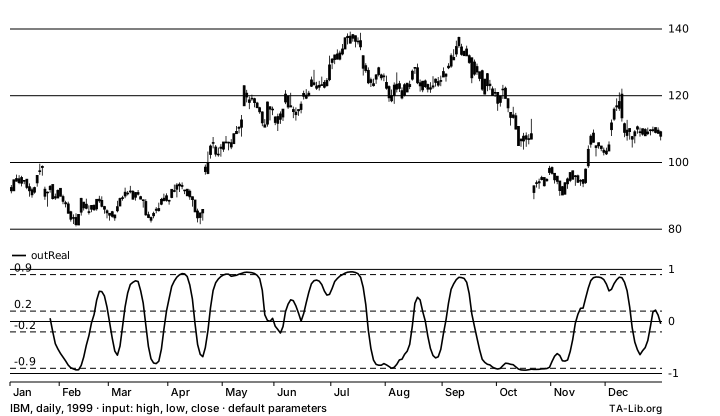
Chart metadata i
Outputs
outReal:line·zero·positive·negative·levels: -0.9, -0.2, 0.2, 0.9
Formula
K = STOCHF(high, low, close, fastKPeriod) (Fast-K only)
NSK = 0.1 * (K - 50)
SS = EMA(EMA(NSK, emaPeriod), emaPeriod)
PSO = (e^SS - 1) / (e^SS + 1) = tanh(SS / 2)
Notes
- The affine step comes before the smoothing, as the author's listing spells it. Smoothing first and recentring after is the same value in real arithmetic and differs in the last bit or two in doubles.
- The squash is computed as
tanh(SS/2), which is the published quotient rewritten. The quotient form isinf/infonceSSexceeds 709.78, which a bar whose close lies outside its own high/low range can reach;tanhsaturates at ±1 instead. - A Fast-K window whose range is zero reads 50, the midpoint, so a flat market reads PSO 0 rather than the near-extreme the Fast-K convention of 0 would give it. The flatness test is the one STOCHF applies, against the window's own extremes rather than a fixed band.
- Each exponential pass is seeded with a simple average of its own first inputs, the same seeding TA-Lib's EMA uses, and the second pass seeds on what the first publishes.
TA_SetUnstablePeriod(TA_FUNC_UNST_EMA, ...)discards more of that warm-up, through both passes. Implementations seeding each pass from a single first sample differ over the transient and agree once it decays. - Leibfarth parameterises the smoothing as the square root of a longer period, 25 in his article. The length is taken here directly, as an integer, because the sources that follow the square root disagree over how to round it.
Inputs
inHigh— High price seriesinLow— Low price seriesinClose— Close price series
Outputs
outReal— Premier Stochastic Oscillator, -1 to +1
Parameters
| Parameter | Type | Default | Accepted values | Description |
|---|---|---|---|---|
optInFastK_Period | integer | 8 | 1–100000 | Time period for building the Fast-K line |
optInEMAPeriod | integer | 5 | 1–100000 | Period of each of the two smoothing passes |
Properties
Numerical Stability: Initial Unstable Period — Inherited from EMA, which PSO computes internally; tunable via EMA's unstable period.
| ☐ Overlap Input |
| ✅ Independent Y-Axis i |
| ☐ Candlestick |
| ☐ Display Shift |
| ☐ Can Output NaN or ±Inf |
| ☐ Identity at Period 1 |
| ✅ Uses Transcendental i |
| ☐ Input Must Be Positive |
Example
#include <stdio.h>
#include <ta_libc.h>

int n = 252;
double high[252]; /* your data, oldest first */
double low[252]; /* your data, oldest first */
double close[252]; /* your data, oldest first */
double out[252];
int outBegIdx, outNBElement;

TA_Initialize();
TA_PSO( 0, n - 1, high, low, close, 8, 5, &outBegIdx, &outNBElement, out );
printf( "%d values from bar %d: [%.4f, ..., %.4f]\n", outNBElement, outBegIdx, out[0], out[outNBElement - 1] );use ta_lib::Core;
let high = vec![0.0; 252]; // your data, oldest first
let low = vec![0.0; 252]; // your data, oldest first
let close = vec![0.0; 252]; // your data, oldest first
let mut out = vec![0.0; 252];
let core = Core::new();
let range = core.pso(0, high.len() - 1, &high, &low, &close, 8, 5, &mut out)?;
println!("{} values from bar {}: [{:.4}, ..., {:.4}]", range.count, range.beg_idx, out[0], out[range.count - 1]);import io.github.talib.Core;
import io.github.talib.OutRange;
import java.util.Locale;
double[] high = new double[252]; // your data, oldest first
double[] low = new double[252]; // your data, oldest first
double[] close = new double[252]; // your data, oldest first
double[] out = new double[252];
Core core = Core.DEFAULT;
OutRange r = core.pso(0, high.length - 1, high, low, close, 8, 5, out);
System.out.printf(Locale.ROOT, "%d values from bar %d: [%.4f, ..., %.4f]%n", r.count(), r.begIdx(), out[0], out[r.count() - 1]);using System;
using TALib;
var high = new double[252]; // your data, oldest first
var low = new double[252]; // your data, oldest first
var close = new double[252]; // your data, oldest first
var outReal = new double[252];
var core = Core.Default;
OutRange r = core.Pso(0, high.Length - 1, high, low, close, 8, 5, outReal);
Console.WriteLine(FormattableString.Invariant($"{r.Count} values from bar {r.BegIdx}: [{outReal[0]:F4}, ..., {outReal[r.Count - 1]:F4}]"));import { pso } from 'ta-lib';
const high = new Float64Array(252); // your data, oldest first
const low = new Float64Array(252); // your data, oldest first
const close = new Float64Array(252); // your data, oldest first
const { begIdx, values } = pso({ high, low, close }, {
fastKPeriod: 8,
emaPeriod: 5,
});
console.log(values.length + ' values from bar ' + begIdx + ': [' + values[0].toFixed(4) + ', ..., ' + values[values.length - 1].toFixed(4) + ']');import (
"fmt"
"log"
talib "ta-lib.github.io/go"
)
high := make([]float64, 252) // your data, oldest first
low := make([]float64, 252) // your data, oldest first
close := make([]float64, 252) // your data, oldest first
out := make([]float64, 252)
core := talib.NewCore()
r, err := core.PSO(0, len(high)-1, high, low, close, 8, 5, out)
if err != nil {
log.Fatal(err)
}
fmt.Printf("%d values from bar %d: [%.4f, ..., %.4f]\n", r.NBElement, r.BegIdx, out[0], out[r.NBElement-1])Implementation
Added in 0.8.3 (ta-lib-python 0.8.3).
TA-Lib Definition: pso.c · pso.yaml
| Native | File |
|---|---|
| C | ta_PSO.c |
| Rust | pso.rs |
| Java | Core_PSO.java |
| C# | Core_PSO.cs |
| TypeScript | pso.ts |
| Go | pso.go |
Python: talib.PSO (ta-lib-python 0.8.3 or later), see ta-lib-python.
TA-Lib is also available for R and more using a wrapper.
Aliases
premier stochastic oscillator, premier stochastic
See Also
References
- Lee Leibfarth, "Premier Stochastic Oscillator", Technical Analysis of Stocks & Commodities, v26:8 (August 2008), pp. 30-36