Ichimoku Kinko Hyo (ICHIMOKU)
Summary
Ichimoku Kinko Hyo, "one glance equilibrium chart": four lines built from highs and lows alone. Goichi Hosoda's reading is that a market's balance is visible without any smoothing — each line is the midpoint of a window, the mean of its highest high and its lowest low, so it marks the level at which that stretch of trading was evenly divided. The conversion line turns fastest, the base line is the reference, and the two leading spans are drawn ahead of price, where the band between them is read as support or resistance before it is reached.
Chart
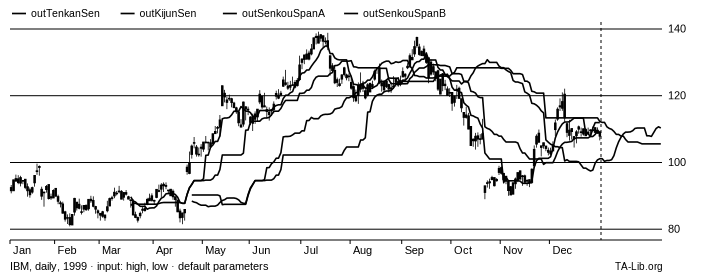
Chart metadata i
Outputs
outTenkanSen:lineoutKijunSen:lineoutSenkouSpanA:line·display_shiftoutSenkouSpanB:line·display_shift
Formula
MID(n) = ( highest high over n bars + lowest low over n bars ) / 2
Tenkan-sen = MID(tenkanPeriod)
Kijun-sen = MID(kijunPeriod)
Senkou Span A = ( Tenkan-sen + Kijun-sen ) / 2
Senkou Span B = MID(senkouBPeriod)
Notes
- Each line is
TA_MIDPRICEover its own period, and Span A isTA_MEDPRICEof the Tenkan and Kijun lines: it halves two midpoints that are already rounded. Averaging the four extremes in one step is the same number in real arithmetic and can differ in the last bit. - The two spans are drawn
kijunPeriodbars ahead of the bar that computed them. That is a display shift:TA_ICHIMOKU_DisplayShiftreports it, and it changes nothing about the values, the lookback or the returned range. Every output is written at the bar that computed it, so the lastkijunPeriodspan values are the cloud a chart draws past the last bar. - Hosoda's 26 counts the current bar, which is a chart offset of 25. QuantConnect LEAN, pandas-ta and MetaTrader offset by 26, and that is what the display shift reports at the default periods; a caller who wants Hosoda's count draws the spans one bar earlier.
- The lookback is the longest of the three periods less one. Nothing orders the three, so any of them can be the longest.
- The Chikou span is the close drawn
kijunPeriodbars back. It carries no computation and is not an output. Its usual signal, the close above the closenbars earlier, isTA_MOM(close, n) > 0.
Inputs
inHigh— High price seriesinLow— Low price series
Outputs
outTenkanSen— Conversion lineoutKijunSen— Base lineoutSenkouSpanA— First leading span, drawn ahead by the base periodoutSenkouSpanB— Second leading span, drawn ahead by the base period
Parameters
| Parameter | Type | Default | Accepted values | Description |
|---|---|---|---|---|
optInTenkanPeriod | integer | 9 | 2–100000 | Period of the conversion line |
optInKijunPeriod | integer | 26 | 2–100000 | Period of the base line, and the forward shift of the two spans |
optInSenkouBPeriod | integer | 52 | 2–100000 | Period of the second leading span |
Properties
Numerical Stability: Start-Independent
| ✅ Overlap Input i |
| ☐ Independent Y-Axis |
| ☐ Candlestick |
| ✅ Display Shift i |
| ☐ Can Output NaN or ±Inf |
| ☐ Identity at Period 1 |
| ☐ Uses Transcendental |
| ☐ Input Must Be Positive |
Example
#include <stdio.h>
#include <ta_libc.h>

int n = 252;
double high[252]; /* your data, oldest first */
double low[252]; /* your data, oldest first */
double tenkanSen[252], kijunSen[252], senkouSpanA[252], senkouSpanB[252];
int outBegIdx, outNBElement;

TA_Initialize();
TA_ICHIMOKU( 0, n - 1, high, low, 9, 26, 52,
             &outBegIdx, &outNBElement, tenkanSen, kijunSen, senkouSpanA, senkouSpanB );
printf( "%d values from bar %d; last tenkanSen = %f\n", outNBElement, outBegIdx, tenkanSen[outNBElement - 1] );use ta_lib::Core;
let high = vec![0.0; 252]; // your data, oldest first
let low = vec![0.0; 252]; // your data, oldest first
let mut tenkan_sen = vec![0.0; 252];
let mut kijun_sen = vec![0.0; 252];
let mut senkou_span_a = vec![0.0; 252];
let mut senkou_span_b = vec![0.0; 252];
let core = Core::new();
let range = core.ichimoku(0, high.len() - 1, &high, &low, 9, 26, 52,
&mut tenkan_sen, &mut kijun_sen, &mut senkou_span_a, &mut senkou_span_b)?;
println!("{} values from bar {}; last tenkan_sen = {}", range.count, range.beg_idx, tenkan_sen[range.count - 1]);import io.github.talib.Core;
import io.github.talib.OutRange;
double[] high = new double[252]; // your data, oldest first
double[] low = new double[252]; // your data, oldest first
double[] tenkanSen = new double[252];
double[] kijunSen = new double[252];
double[] senkouSpanA = new double[252];
double[] senkouSpanB = new double[252];
Core core = Core.DEFAULT;
OutRange r = core.ichimoku(0, high.length - 1, high, low, 9, 26, 52,
tenkanSen, kijunSen, senkouSpanA, senkouSpanB);
System.out.println(r.count() + " values from bar " + r.begIdx() + "; last tenkanSen = " + tenkanSen[r.count() - 1]);using System;
using TALib;
var high = new double[252]; // your data, oldest first
var low = new double[252]; // your data, oldest first
var tenkanSen = new double[252];
var kijunSen = new double[252];
var senkouSpanA = new double[252];
var senkouSpanB = new double[252];
var core = Core.Default;
OutRange r = core.Ichimoku(0, high.Length - 1, high, low, 9, 26, 52,
tenkanSen, kijunSen, senkouSpanA, senkouSpanB);
Console.WriteLine($"{r.Count} values from bar {r.BegIdx}; last tenkanSen = {tenkanSen[r.Count - 1]}");import { ichimoku } from 'ta-lib';
const high = new Float64Array(252); // your data, oldest first
const low = new Float64Array(252); // your data, oldest first
const {
begIdx,
outTenkanSen,
outKijunSen,
outSenkouSpanA,
outSenkouSpanB,
} = ichimoku({ high, low }, {
tenkanPeriod: 9,
kijunPeriod: 26,
senkouBPeriod: 52,
});
console.log(outTenkanSen.length + ' values from bar ' + begIdx + '; last outTenkanSen = ' + outTenkanSen[outTenkanSen.length - 1]);Implementation
Added in 0.8.3 (ta-lib-python 0.8.3).
TA-Lib Definition: ichimoku.c · ichimoku.yaml
| Native | File |
|---|---|
| C | ta_ICHIMOKU.c |
| Rust | ichimoku.rs |
| Java | Core_ICHIMOKU.java |
| C# | Core_ICHIMOKU.cs |
| TypeScript | ichimoku.ts |
Python: talib.ICHIMOKU (ta-lib-python 0.8.3 or later), see ta-lib-python.
TA-Lib is also available for R and more using a wrapper.
Aliases
ichimoku, ichimoku kinko hyo, ichimoku cloud, kumo
See Also
MIDPRICE · MEDPRICE · SAR · BBANDS
References
- Goichi Hosoda, Ichimoku Kinko Hyo, 1969