Heikin-Ashi Candles (HA)
Summary
Heikin-Ashi candles: an OHLC-to-OHLC transform that replaces each bar with a smoothed synthetic candle. The synthetic close is the bar's four-price average, the synthetic open is the midpoint of the previous synthetic candle's own open and close, and the synthetic high and low extend the raw extremes far enough to contain that pair.
Read the result as a trend filter rather than as price: consecutive candles of one colour run longer than on the raw chart, small counter-trend bars are absorbed, and a candle with no shadow on the trend side is the usual continuation cue. The cost is that the synthetic open and close are not tradeable prices and gaps disappear entirely, so orders must still be placed against the raw series.
HA is recursive: every candle carries the previous one, so the first candle of a request is seeded from its own bar and its influence halves on each bar that follows.
Chart
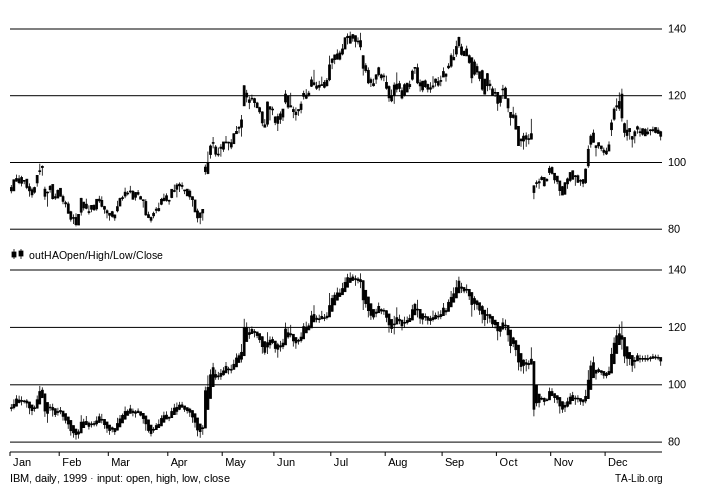
Chart metadata i
Outputs
outHAOpen:lineoutHAHigh:line·upper_limitoutHALow:line·lower_limitoutHAClose:line
Formula
HA_close[i] = ( O[i] + H[i] + L[i] + C[i] ) / 4
HA_open[0] = ( O[0] + C[0] ) / 2 HA_open[i] = ( HA_open[i-1] + HA_close[i-1] ) / 2
HA_high[i] = max( H[i], HA_open[i], HA_close[i] ) HA_low[i] = min( L[i], HA_open[i], HA_close[i] )
Notes
- The first candle has no predecessor, so its open is seeded with the midpoint of the raw open and close. Other conventions exist — ta4j emits the raw bar unchanged as its first candle — and they differ only while the seed still carries weight.
- Both divisors are exact powers of two, so implementations that scale by
0.5and0.25produce the same doubles as those that divide by 2 and 4. - The unstable period discards candles of warm-up before the first output, trading history for a smaller residual difference between two requests that start at different bars.
- Averaging four prices of one bar is also what
AVGPRICEcomputes, but it sums them in a different order, so the two can differ in the last bits.
Inputs
inOpen— Open price of each barinHigh— High price of each barinLow— Low price of each barinClose— Close price of each bar
Outputs
outHAOpen— Heikin-Ashi openoutHAHigh— Heikin-Ashi highoutHALow— Heikin-Ashi lowoutHAClose— Heikin-Ashi close
Properties
Numerical Stability: Initial Unstable Period
| ✅ Overlap Input i |
| ☐ Independent Y-Axis |
| ☐ Candlestick |
| ☐ Display Shift |
| ☐ Can Output NaN or ±Inf |
| ☐ Identity at Period 1 |
| ☐ Uses Transcendental |
| ☐ Input Must Be Positive |
Example
#include <stdio.h>
#include <ta_libc.h>

int n = 252;
double open[252]; /* your data, oldest first */
double high[252]; /* your data, oldest first */
double low[252]; /* your data, oldest first */
double close[252]; /* your data, oldest first */
double haOpen[252], haHigh[252], haLow[252], haClose[252];
int outBegIdx, outNBElement;

TA_Initialize();
TA_HA( 0, n - 1, open, high, low, close,
       &outBegIdx, &outNBElement, haOpen, haHigh, haLow, haClose );
printf( "%d values from bar %d:\n", outNBElement, outBegIdx );
printf( "haOpen = [%.4f, ..., %.4f]\n", haOpen[0], haOpen[outNBElement - 1] );
printf( "haHigh = [%.4f, ..., %.4f]\n", haHigh[0], haHigh[outNBElement - 1] );
printf( "haLow = [%.4f, ..., %.4f]\n", haLow[0], haLow[outNBElement - 1] );
printf( "haClose = [%.4f, ..., %.4f]\n", haClose[0], haClose[outNBElement - 1] );use ta_lib::Core;
let open = vec![0.0; 252]; // your data, oldest first
let high = vec![0.0; 252]; // your data, oldest first
let low = vec![0.0; 252]; // your data, oldest first
let close = vec![0.0; 252]; // your data, oldest first
let mut ha_open = vec![0.0; 252];
let mut ha_high = vec![0.0; 252];
let mut ha_low = vec![0.0; 252];
let mut ha_close = vec![0.0; 252];
let core = Core::new();
let range = core.ha(0, open.len() - 1, &open, &high, &low, &close,
&mut ha_open, &mut ha_high, &mut ha_low, &mut ha_close)?;
println!("{} values from bar {}:", range.count, range.beg_idx);
println!("ha_open = [{:.4}, ..., {:.4}]", ha_open[0], ha_open[range.count - 1]);
println!("ha_high = [{:.4}, ..., {:.4}]", ha_high[0], ha_high[range.count - 1]);
println!("ha_low = [{:.4}, ..., {:.4}]", ha_low[0], ha_low[range.count - 1]);
println!("ha_close = [{:.4}, ..., {:.4}]", ha_close[0], ha_close[range.count - 1]);import io.github.talib.Core;
import io.github.talib.OutRange;
import java.util.Locale;
double[] open = new double[252]; // your data, oldest first
double[] high = new double[252]; // your data, oldest first
double[] low = new double[252]; // your data, oldest first
double[] close = new double[252]; // your data, oldest first
double[] haOpen = new double[252];
double[] haHigh = new double[252];
double[] haLow = new double[252];
double[] haClose = new double[252];
Core core = Core.DEFAULT;
OutRange r = core.ha(0, open.length - 1, open, high, low, close, haOpen, haHigh, haLow, haClose);
System.out.printf(Locale.ROOT, "%d values from bar %d:%n", r.count(), r.begIdx());
System.out.printf(Locale.ROOT, "haOpen = [%.4f, ..., %.4f]%n", haOpen[0], haOpen[r.count() - 1]);
System.out.printf(Locale.ROOT, "haHigh = [%.4f, ..., %.4f]%n", haHigh[0], haHigh[r.count() - 1]);
System.out.printf(Locale.ROOT, "haLow = [%.4f, ..., %.4f]%n", haLow[0], haLow[r.count() - 1]);
System.out.printf(Locale.ROOT, "haClose = [%.4f, ..., %.4f]%n", haClose[0], haClose[r.count() - 1]);using System;
using TALib;
var open = new double[252]; // your data, oldest first
var high = new double[252]; // your data, oldest first
var low = new double[252]; // your data, oldest first
var close = new double[252]; // your data, oldest first
var haOpen = new double[252];
var haHigh = new double[252];
var haLow = new double[252];
var haClose = new double[252];
var core = Core.Default;
OutRange r = core.Ha(0, open.Length - 1, open, high, low, close, haOpen, haHigh, haLow, haClose);
Console.WriteLine($"{r.Count} values from bar {r.BegIdx}:");
Console.WriteLine(FormattableString.Invariant($"haOpen = [{haOpen[0]:F4}, ..., {haOpen[r.Count - 1]:F4}]"));
Console.WriteLine(FormattableString.Invariant($"haHigh = [{haHigh[0]:F4}, ..., {haHigh[r.Count - 1]:F4}]"));
Console.WriteLine(FormattableString.Invariant($"haLow = [{haLow[0]:F4}, ..., {haLow[r.Count - 1]:F4}]"));
Console.WriteLine(FormattableString.Invariant($"haClose = [{haClose[0]:F4}, ..., {haClose[r.Count - 1]:F4}]"));import { ha } from 'ta-lib';
const open = new Float64Array(252); // your data, oldest first
const high = new Float64Array(252); // your data, oldest first
const low = new Float64Array(252); // your data, oldest first
const close = new Float64Array(252); // your data, oldest first
const {
begIdx,
outHaOpen,
outHaHigh,
outHaLow,
outHaClose,
} = ha({ open, high, low, close });
console.log(outHaOpen.length + ' values from bar ' + begIdx + ':');
console.log('outHaOpen = [' + outHaOpen[0].toFixed(4) + ', ..., ' + outHaOpen[outHaOpen.length - 1].toFixed(4) + ']');
console.log('outHaHigh = [' + outHaHigh[0].toFixed(4) + ', ..., ' + outHaHigh[outHaHigh.length - 1].toFixed(4) + ']');
console.log('outHaLow = [' + outHaLow[0].toFixed(4) + ', ..., ' + outHaLow[outHaLow.length - 1].toFixed(4) + ']');
console.log('outHaClose = [' + outHaClose[0].toFixed(4) + ', ..., ' + outHaClose[outHaClose.length - 1].toFixed(4) + ']');import (
"fmt"
"log"
talib "ta-lib.github.io/go"
)
open := make([]float64, 252) // your data, oldest first
high := make([]float64, 252) // your data, oldest first
low := make([]float64, 252) // your data, oldest first
close := make([]float64, 252) // your data, oldest first
haOpen := make([]float64, 252)
haHigh := make([]float64, 252)
haLow := make([]float64, 252)
haClose := make([]float64, 252)
core := talib.NewCore()
r, err := core.HA(0, len(open)-1, open, high, low, close, haOpen, haHigh, haLow, haClose)
if err != nil {
log.Fatal(err)
}
fmt.Printf("%d values from bar %d:\n", r.NBElement, r.BegIdx)
fmt.Printf("haOpen = [%.4f, ..., %.4f]\n", haOpen[0], haOpen[r.NBElement-1])
fmt.Printf("haHigh = [%.4f, ..., %.4f]\n", haHigh[0], haHigh[r.NBElement-1])
fmt.Printf("haLow = [%.4f, ..., %.4f]\n", haLow[0], haLow[r.NBElement-1])
fmt.Printf("haClose = [%.4f, ..., %.4f]\n", haClose[0], haClose[r.NBElement-1])Implementation
Added in 0.8.1 (ta-lib-python 0.8.1).
TA-Lib Definition: ha.c · ha.yaml
| Native | File |
|---|---|
| C | ta_HA.c |
| Rust | ha.rs |
| Java | Core_HA.java |
| C# | Core_HA.cs |
| TypeScript | ha.ts |
| Go | ha.go |
Python: talib.HA (ta-lib-python 0.8.1 or later), see ta-lib-python.
TA-Lib is also available for R and more using a wrapper.
Aliases
Heikin-Ashi, Heikin Ashi Candles, Heiken Ashi, Average Bar
See Also
AVGPRICE · MEDPRICE · TYPPRICE · WCLPRICE
References
- StockCharts ChartSchool, Heikin-Ashi Candlesticks — the four formulas and the seeding convention used here.
- Investopedia, Heikin-Ashi Technique — interpretation and the trading caveats.