Gator Oscillator (GATOR)
Summary
Bill Williams' Gator Oscillator: how far apart the three Alligator lines are, as two histograms. The upper bars are the gap between Jaw and Teeth, the lower bars the gap between Teeth and Lips drawn below zero. Both growing is the alligator eating, a trend under way; both shrinking toward zero is it falling asleep, the lines converging in a range. One side growing while the other shrinks is it waking or sated, the turn from one state into the other.
It is read under the Alligator (ALLIGATOR), the Profitunity leg it measures.
Chart
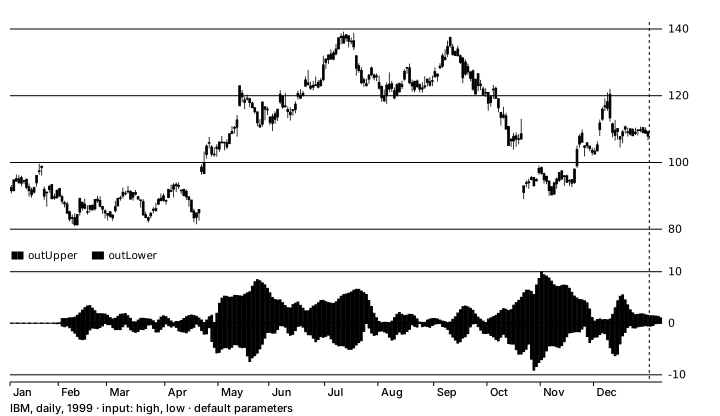
Chart metadata i
Drawn on the price pane over candles; below it, a separate indicator pane with a zero line showing outUpper as a sign-coloured histogram moved 5 bars forward and outLower as a sign-coloured histogram moved 3 bars forward.
Metadata flags used: inPriceHL: high, low · outUpper: histogram, display_shift (+5) · outLower: histogram, display_shift (+3)
Reference data (CSV) · Chart (SVG)
Formula
Jaw, Teeth and Lips are the three ALLIGATOR lines, each drawn its own shift ahead. The histograms compare them where a chart draws them:
Upper = | Jaw − Teeth |
Lower = −| Teeth − Lips |
Notes
- Each line is drawn ahead by its own shift, so the line drawn further ahead is read back by the difference of the two shifts.
TA_GATOR_DisplayShiftreports where a chart draws each histogram, the smaller of its two lines' shifts; it changes nothing about the values or the returned range. - Each histogram computes its own lines, each seeded over the bars its own lookback reaches back, so the Teeth an output reads can differ from the
TA_ALLIGATORTeeth by the seed until it has decayed; setting theRMAunstable period closes the gap. - A zero Lower is
+0.0.
Inputs
inHigh— High price of each barinLow— Low price of each bar
Outputs
outUpper— Gap between the Jaw and the Teeth, zero or aboveoutLower— Gap between the Teeth and the Lips, zero or below
Parameters
| Parameter | Type | Default | Accepted values | Description |
|---|---|---|---|---|
optInJawPeriod | integer | 13 | 1–100000 | Number of bars in the jaw's smoothed moving average. |
optInJawShift | integer | 8 | 0–100000 | Bars ahead of the computing bar at which a chart draws the jaw. |
optInTeethPeriod | integer | 8 | 1–100000 | Number of bars in the teeth's smoothed moving average. |
optInTeethShift | integer | 5 | 0–100000 | Bars ahead of the computing bar at which a chart draws the teeth. |
optInLipsPeriod | integer | 5 | 1–100000 | Number of bars in the lips' smoothed moving average. |
optInLipsShift | integer | 3 | 0–100000 | Bars ahead of the computing bar at which a chart draws the lips. |
Properties
Numerical Stability: Initial Unstable Period — Inherited from RMA, which GATOR computes internally; tunable via RMA's unstable period.
| ☐ Overlap Input |
| ✅ Independent Y-Axis i |
| ☐ Candlestick |
| ☐ Can Output NaN or ±Inf |
| ☐ Identity at Period 1 |
| ✅ Display Shift i |
| ☐ Uses Transcendental |
| ☐ Input Must Be Positive |
Example
#include <stdio.h>
#include <ta_libc.h>

int n = 252;
double high[252]; /* your data, oldest first */
double low[252]; /* your data, oldest first */
double upper[252], lower[252];
int outBegIdx, outNBElement;

TA_Initialize();
TA_GATOR( 0, n - 1, high, low, 13, 8, 8, 5, 5, 3, &outBegIdx, &outNBElement, upper, lower );
printf( "%d values from bar %d; last upper = %f\n", outNBElement, outBegIdx, upper[outNBElement - 1] );use ta_lib::Core;
let high = vec![0.0; 252]; // your data, oldest first
let low = vec![0.0; 252]; // your data, oldest first
let mut upper = vec![0.0; 252];
let mut lower = vec![0.0; 252];
let core = Core::new();
let range = core.gator(0, high.len() - 1, &high, &low, 13, 8, 8, 5, 5, 3,
&mut upper, &mut lower)?;
println!("{} values from bar {}; last upper = {}", range.count, range.beg_idx, upper[range.count - 1]);import io.github.talib.Core;
import io.github.talib.OutRange;
double[] high = new double[252]; // your data, oldest first
double[] low = new double[252]; // your data, oldest first
double[] upper = new double[252];
double[] lower = new double[252];
Core core = Core.DEFAULT;
OutRange r = core.gator(0, high.length - 1, high, low, 13, 8, 8, 5, 5, 3, upper, lower);
System.out.println(r.count() + " values from bar " + r.begIdx() + "; last upper = " + upper[r.count() - 1]);using System;
using TALib;
var high = new double[252]; // your data, oldest first
var low = new double[252]; // your data, oldest first
var upper = new double[252];
var lower = new double[252];
var core = Core.Default;
OutRange r = core.Gator(0, high.Length - 1, high, low, 13, 8, 8, 5, 5, 3, upper, lower);
Console.WriteLine($"{r.Count} values from bar {r.BegIdx}; last upper = {upper[r.Count - 1]}");import { gator } from 'ta-lib';
const high = new Float64Array(252); // your data, oldest first
const low = new Float64Array(252); // your data, oldest first
const { begIdx, outUpper, outLower } = gator({ high, low }, {
jawPeriod: 13,
jawShift: 8,
teethPeriod: 8,
teethShift: 5,
lipsPeriod: 5,
lipsShift: 3,
});
console.log(outUpper.length + ' values from bar ' + begIdx + '; last outUpper = ' + outUpper[outUpper.length - 1]);Implementation
Added in 0.8.4.
TA-Lib Definition: gator.c · gator.yaml
| Native | File |
|---|---|
| C | ta_GATOR.c |
| Rust | gator.rs |
| Java | Core_GATOR.java |
| C# | Core_GATOR.cs |
| TypeScript | gator.ts |
Python: talib.GATOR, see ta-lib-python.
TA-Lib is also available for R and more using a wrapper.
Aliases
gator oscillator, williams gator
See Also
References
- Bill Williams, New Trading Dimensions, 1998