Donchian Channels (DONCHIAN)
Summary
Donchian Channels: three overlap lines built from rolling price extrema. The upper band is the highest high and the lower band the lowest low over the period; the middle line is their midpoint. Richard Donchian's original four-week rule — generally credited as the first published systematic trend-following system — buys a break above the high of the preceding weeks and sells a break below their low.
Chart
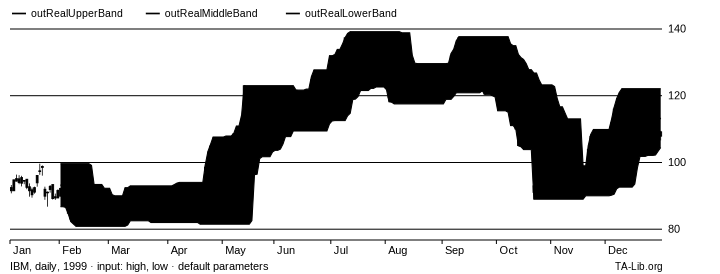
Chart metadata i
Outputs
outRealUpperBand:upper_limitoutRealMiddleBand:lineoutRealLowerBand:lower_limit
Formula
Window = the optInTimePeriod bars ending at the current bar
Upper = Highest High of Window Lower = Lowest Low of Window Middle = (Upper + Lower) / 2
Notes
- The window includes the current bar, matching TradingView (
ta.highest/ta.lowest), NinjaTrader, ta4j, pandas-ta and every other library that ships Donchian Channels. - A breakout rule compares the current bar against the previous bar's band —
High[t] > Upper[t-1]— which is where the one-bar offset belongs. ReadingUpper[t]againstHigh[t]can never signal, becauseHigh[t]is inside the window that produced it. - Upper, Middle and Lower are bit-identical to
MAX(high, N),MIDPRICE(N)andMIN(low, N). DONCHIAN computes all three in one pass under the name users look for. - The middle line is the channel midpoint, not a moving average of price.
- No smoothing or recursion is involved, so there is no unstable period: outputs are exact from the first bar.
Inputs
inHigh— High price of each barinLow— Low price of each bar
Outputs
outRealUpperBand— Highest high of the windowoutRealMiddleBand— Midpoint of the upper and lower bandsoutRealLowerBand— Lowest low of the window
Parameters
| Parameter | Type | Default | Accepted values | Description |
|---|---|---|---|---|
optInTimePeriod | integer | 20 | 2–100000 | Number of bars in the extrema window |
Properties
Numerical Stability: Start-Independent
| ✅ Overlap Input i |
| ☐ Independent Y-Axis |
| ☐ Candlestick |
| ☐ Display Shift |
| ☐ Can Output NaN or ±Inf |
| ☐ Identity at Period 1 |
| ☐ Uses Transcendental |
| ☐ Input Must Be Positive |
Example
#include <stdio.h>
#include <ta_libc.h>

int n = 252;
double high[252]; /* your data, oldest first */
double low[252]; /* your data, oldest first */
double upperBand[252], middleBand[252], lowerBand[252];
int outBegIdx, outNBElement;

TA_Initialize();
TA_DONCHIAN( 0, n - 1, high, low, 20, &outBegIdx, &outNBElement, upperBand, middleBand, lowerBand );
printf( "%d values from bar %d:\n", outNBElement, outBegIdx );
printf( "upperBand = [%.4f, ..., %.4f]\n", upperBand[0], upperBand[outNBElement - 1] );
printf( "middleBand = [%.4f, ..., %.4f]\n", middleBand[0], middleBand[outNBElement - 1] );
printf( "lowerBand = [%.4f, ..., %.4f]\n", lowerBand[0], lowerBand[outNBElement - 1] );use ta_lib::Core;
let high = vec![0.0; 252]; // your data, oldest first
let low = vec![0.0; 252]; // your data, oldest first
let mut upper_band = vec![0.0; 252];
let mut middle_band = vec![0.0; 252];
let mut lower_band = vec![0.0; 252];
let core = Core::new();
let range = core.donchian(0, high.len() - 1, &high, &low, 20,
&mut upper_band, &mut middle_band, &mut lower_band)?;
println!("{} values from bar {}:", range.count, range.beg_idx);
println!("upper_band = [{:.4}, ..., {:.4}]", upper_band[0], upper_band[range.count - 1]);
println!("middle_band = [{:.4}, ..., {:.4}]", middle_band[0], middle_band[range.count - 1]);
println!("lower_band = [{:.4}, ..., {:.4}]", lower_band[0], lower_band[range.count - 1]);import io.github.talib.Core;
import io.github.talib.OutRange;
import java.util.Locale;
double[] high = new double[252]; // your data, oldest first
double[] low = new double[252]; // your data, oldest first
double[] upperBand = new double[252];
double[] middleBand = new double[252];
double[] lowerBand = new double[252];
Core core = Core.DEFAULT;
OutRange r = core.donchian(0, high.length - 1, high, low, 20, upperBand, middleBand, lowerBand);
System.out.printf(Locale.ROOT, "%d values from bar %d:%n", r.count(), r.begIdx());
System.out.printf(Locale.ROOT, "upperBand = [%.4f, ..., %.4f]%n", upperBand[0], upperBand[r.count() - 1]);
System.out.printf(Locale.ROOT, "middleBand = [%.4f, ..., %.4f]%n", middleBand[0], middleBand[r.count() - 1]);
System.out.printf(Locale.ROOT, "lowerBand = [%.4f, ..., %.4f]%n", lowerBand[0], lowerBand[r.count() - 1]);using System;
using TALib;
var high = new double[252]; // your data, oldest first
var low = new double[252]; // your data, oldest first
var upperBand = new double[252];
var middleBand = new double[252];
var lowerBand = new double[252];
var core = Core.Default;
OutRange r = core.Donchian(0, high.Length - 1, high, low, 20, upperBand, middleBand, lowerBand);
Console.WriteLine($"{r.Count} values from bar {r.BegIdx}:");
Console.WriteLine(FormattableString.Invariant($"upperBand = [{upperBand[0]:F4}, ..., {upperBand[r.Count - 1]:F4}]"));
Console.WriteLine(FormattableString.Invariant($"middleBand = [{middleBand[0]:F4}, ..., {middleBand[r.Count - 1]:F4}]"));
Console.WriteLine(FormattableString.Invariant($"lowerBand = [{lowerBand[0]:F4}, ..., {lowerBand[r.Count - 1]:F4}]"));import { donchian } from 'ta-lib';
const high = new Float64Array(252); // your data, oldest first
const low = new Float64Array(252); // your data, oldest first
const {
begIdx,
outUpperBand,
outMiddleBand,
outLowerBand,
} = donchian({ high, low }, { timePeriod: 20 });
console.log(outUpperBand.length + ' values from bar ' + begIdx + ':');
console.log('outUpperBand = [' + outUpperBand[0].toFixed(4) + ', ..., ' + outUpperBand[outUpperBand.length - 1].toFixed(4) + ']');
console.log('outMiddleBand = [' + outMiddleBand[0].toFixed(4) + ', ..., ' + outMiddleBand[outMiddleBand.length - 1].toFixed(4) + ']');
console.log('outLowerBand = [' + outLowerBand[0].toFixed(4) + ', ..., ' + outLowerBand[outLowerBand.length - 1].toFixed(4) + ']');import (
"fmt"
"log"
talib "ta-lib.github.io/go"
)
high := make([]float64, 252) // your data, oldest first
low := make([]float64, 252) // your data, oldest first
upperBand := make([]float64, 252)
middleBand := make([]float64, 252)
lowerBand := make([]float64, 252)
core := talib.NewCore()
r, err := core.DONCHIAN(0, len(high)-1, high, low, 20, upperBand, middleBand, lowerBand)
if err != nil {
log.Fatal(err)
}
fmt.Printf("%d values from bar %d:\n", r.NBElement, r.BegIdx)
fmt.Printf("upperBand = [%.4f, ..., %.4f]\n", upperBand[0], upperBand[r.NBElement-1])
fmt.Printf("middleBand = [%.4f, ..., %.4f]\n", middleBand[0], middleBand[r.NBElement-1])
fmt.Printf("lowerBand = [%.4f, ..., %.4f]\n", lowerBand[0], lowerBand[r.NBElement-1])Implementation
Added in 0.8.1 (ta-lib-python 0.8.1).
TA-Lib Definition: donchian.c · donchian.yaml
| Native | File |
|---|---|
| C | ta_DONCHIAN.c |
| Rust | donchian.rs |
| Java | Core_DONCHIAN.java |
| C# | Core_DONCHIAN.cs |
| TypeScript | donchian.ts |
| Go | donchian.go |
Python: talib.DONCHIAN (ta-lib-python 0.8.1 or later), see ta-lib-python.
TA-Lib is also available for R and more using a wrapper.