Tristar Pattern (CDLTRISTAR)
Summary
A three-candle pattern of three consecutive doji where the middle doji is a star (its body gaps away from the first). Bullish or bearish reversal signal.
Chart
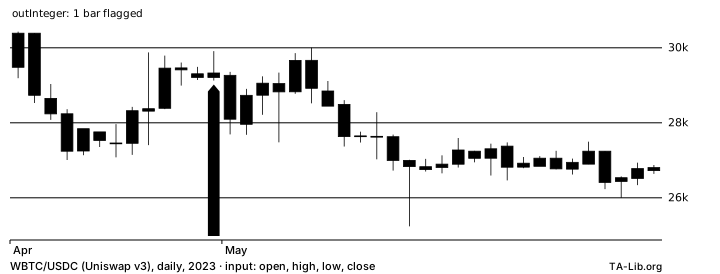
Chart metadata i
Outputs
outInteger:pattern_bull_bear·zero·positive·negative
Notes
- This reversal pattern does not verify the prior trend it classically assumes.
- Bulkowski's testing found both Tristar variants reverse only marginally better than chance: bullish 60% of the time (rank 28/103 overall) and bearish just 52% of the time (rank 76/103). Despite the "exhaustion signal" framing, it is one of the weaker reversal signals in his candlestick set. (thepatternsite.com)
- Rare: a few years of one symbol's daily bars may show none. Bulkowski ranks the bullish form 79th and the bearish 77th of 103 patterns by how often they occur (bullish, bearish), and it fires 5 times in about 16,000 daily crypto bars.
Inputs
inOpen— Open price of each barinHigh— High price of each barinLow— Low price of each barinClose— Close price of each bar
Outputs
outInteger— +100 (bullish, star gapped down), -100 (bearish, star gapped up), or 0 when no pattern. Both signs are emitted
Output Values
What candlestick values mean: Candlestick Outputs. The function's flags declare which values it can return: rW7.
| Value | Meaning |
|---|---|
| -100 | Bearish Tristar: the middle doji ("star") gaps up from the first, and the top of the third's body stays below the star's; an exhaustion signal warning an uptrend may be topping out |
| 0 | No pattern (or a doji trio without a qualifying star gap) |
| 100 | Bullish Tristar: the middle doji ("star") gaps down from the first, and the bottom of the third's body stays above the star's; an exhaustion signal warning a downtrend may be bottoming out |
Properties
Numerical Stability: Start-Independent
| ☐ Overlap Input |
| ✅ Independent Y-Axis i |
| ✅ Candlestick i |
| ☐ Display Shift |
| ☐ Can Output NaN or ±Inf |
| ☐ Identity at Period 1 |
| ☐ Uses Transcendental |
| ☐ Input Must Be Positive |
Example
C
#include <stdio.h>
#include <ta_libc.h>

int n = 252;
double open[252]; /* your data, oldest first */
double high[252]; /* your data, oldest first */
double low[252]; /* your data, oldest first */
double close[252]; /* your data, oldest first */
int out[252];
int outBegIdx, outNBElement;

TA_Initialize();
TA_CDLTRISTAR( 0, n - 1, open, high, low, close, &outBegIdx, &outNBElement, out );
printf( "%d values from bar %d; last out = %d\n", outNBElement, outBegIdx, out[outNBElement - 1] );
Rust
use ta_lib::Core;

let open = vec![0.0; 252]; // your data, oldest first
let high = vec![0.0; 252]; // your data, oldest first
let low = vec![0.0; 252]; // your data, oldest first
let close = vec![0.0; 252]; // your data, oldest first
let mut out = vec![0i32; 252];

let core = Core::new();
let range = core.cdltristar(0, open.len() - 1, &open, &high, &low, &close, &mut out)?;
println!("{} values from bar {}; last out = {}", range.count, range.beg_idx, out[range.count - 1]);
Java
import io.github.talib.Core;
import io.github.talib.OutRange;

double[] open = new double[252]; // your data, oldest first
double[] high = new double[252]; // your data, oldest first
double[] low = new double[252]; // your data, oldest first
double[] close = new double[252]; // your data, oldest first
int[] out = new int[252];

Core core = Core.DEFAULT;
OutRange r = core.cdltristar(0, open.length - 1, open, high, low, close, out);
System.out.println(r.count() + " values from bar " + r.begIdx() + "; last out = " + out[r.count() - 1]);
C#
using System;
using TALib;

var open = new double[252]; // your data, oldest first
var high = new double[252]; // your data, oldest first
var low = new double[252]; // your data, oldest first
var close = new double[252]; // your data, oldest first
var outInteger = new int[252];

var core = Core.Default;
OutRange r = core.Cdltristar(0, open.Length - 1, open, high, low, close, outInteger);
Console.WriteLine($"{r.Count} values from bar {r.BegIdx}; last outInteger = {outInteger[r.Count - 1]}");
TypeScript
import { cdltristar } from 'ta-lib';

const open = new Float64Array(252); // your data, oldest first
const high = new Float64Array(252); // your data, oldest first
const low = new Float64Array(252); // your data, oldest first
const close = new Float64Array(252); // your data, oldest first

const { begIdx, values } = cdltristar({ open, high, low, close });
console.log(values.length + ' values from bar ' + begIdx + '; last values = ' + values[values.length - 1]);
Implementation
Added in 0.4.0.
TA-Lib Definition: cdltristar.c · cdltristar.yaml
| Native | File |
|---|---|
| C | ta_CDLTRISTAR.c |
| Rust | cdltristar.rs |
| Java | Core_CDLTRISTAR.java |
| C# | Core_CDLTRISTAR.cs |
| TypeScript | cdltristar.ts |
Python: talib.CDLTRISTAR, see ta-lib-python.
TA-Lib is also available for R and more using a wrapper.
Aliases
Tristar Pattern, Tri-Star
See Also
CDLDOJI · CDLDOJISTAR · CDLMORNINGDOJISTAR · CDLEVENINGDOJISTAR