Piercing Pattern (CDLPIERCING)
Summary
Two-candle pattern: a long black candle followed by a long white candle that opens below the prior low and closes back above the midpoint of the prior black body. Bullish reversal signal. A hit (+100) is a bullish reversal signal.
Chart
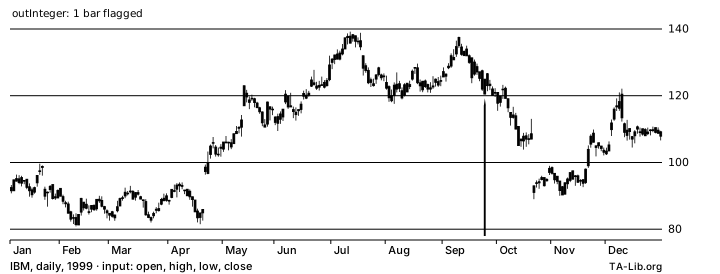
Chart metadata i
Outputs
outInteger:pattern_bull_bear·zero·positive
Notes
- A prior downtrend is not verified.
Inputs
inOpen— Open price of each barinHigh— High price of each barinLow— Low price of each barinClose— Close price of each bar
Outputs
outInteger— +100 when the piercing pattern is detected; 0 otherwise. Always bullish, never emits -100
Output Values
What candlestick values mean: Candlestick Outputs. The function's flags declare which values it can return: rW7.
| Value | Meaning |
|---|---|
| 0 | No pattern |
| 100 | Piercing pattern detected — bullish reversal signal |
Properties
Numerical Stability: Start-Independent
| ☐ Overlap Input |
| ✅ Independent Y-Axis i |
| ✅ Candlestick i |
| ☐ Display Shift |
| ☐ Can Output NaN or ±Inf |
| ☐ Identity at Period 1 |
| ☐ Uses Transcendental |
| ☐ Input Must Be Positive |
Example
C
#include <stdio.h>
#include <ta_libc.h>

int n = 252;
double open[252]; /* your data, oldest first */
double high[252]; /* your data, oldest first */
double low[252]; /* your data, oldest first */
double close[252]; /* your data, oldest first */
int out[252];
int outBegIdx, outNBElement;

TA_Initialize();
TA_CDLPIERCING( 0, n - 1, open, high, low, close, &outBegIdx, &outNBElement, out );
printf( "%d values from bar %d; last out = %d\n", outNBElement, outBegIdx, out[outNBElement - 1] );
Rust
use ta_lib::Core;

let open = vec![0.0; 252]; // your data, oldest first
let high = vec![0.0; 252]; // your data, oldest first
let low = vec![0.0; 252]; // your data, oldest first
let close = vec![0.0; 252]; // your data, oldest first
let mut out = vec![0i32; 252];

let core = Core::new();
let range = core.cdlpiercing(0, open.len() - 1, &open, &high, &low, &close, &mut out)?;
println!("{} values from bar {}; last out = {}", range.count, range.beg_idx, out[range.count - 1]);
Java
import io.github.talib.Core;
import io.github.talib.OutRange;

double[] open = new double[252]; // your data, oldest first
double[] high = new double[252]; // your data, oldest first
double[] low = new double[252]; // your data, oldest first
double[] close = new double[252]; // your data, oldest first
int[] out = new int[252];

Core core = Core.DEFAULT;
OutRange r = core.cdlpiercing(0, open.length - 1, open, high, low, close, out);
System.out.println(r.count() + " values from bar " + r.begIdx() + "; last out = " + out[r.count() - 1]);
C#
using System;
using TALib;

var open = new double[252]; // your data, oldest first
var high = new double[252]; // your data, oldest first
var low = new double[252]; // your data, oldest first
var close = new double[252]; // your data, oldest first
var outInteger = new int[252];

var core = Core.Default;
OutRange r = core.Cdlpiercing(0, open.Length - 1, open, high, low, close, outInteger);
Console.WriteLine($"{r.Count} values from bar {r.BegIdx}; last outInteger = {outInteger[r.Count - 1]}");
TypeScript
import { cdlpiercing } from 'ta-lib';

const open = new Float64Array(252); // your data, oldest first
const high = new Float64Array(252); // your data, oldest first
const low = new Float64Array(252); // your data, oldest first
const close = new Float64Array(252); // your data, oldest first

const { begIdx, values } = cdlpiercing({ open, high, low, close });
console.log(values.length + ' values from bar ' + begIdx + '; last values = ' + values[values.length - 1]);
Implementation
Added in 0.4.0.
TA-Lib Definition: cdlpiercing.c · cdlpiercing.yaml
| Native | File |
|---|---|
| C | ta_CDLPIERCING.c |
| Rust | cdlpiercing.rs |
| Java | Core_CDLPIERCING.java |
| C# | Core_CDLPIERCING.cs |
| TypeScript | cdlpiercing.ts |
Python: talib.CDLPIERCING, see ta-lib-python.
TA-Lib is also available for R and more using a wrapper.
Aliases
Piercing Pattern, Piercing Line