Hikkake Pattern (CDLHIKKAKE)
Summary
A 3-bar pattern: an inside bar followed by a false breakout, optionally later confirmed by a follow-through bar. Signals a bullish or bearish reversal/continuation depending on the breakout direction. A false-breakout setup: positive = bullish, negative = bearish; magnitude 200 flags the confirming bar.
Chart
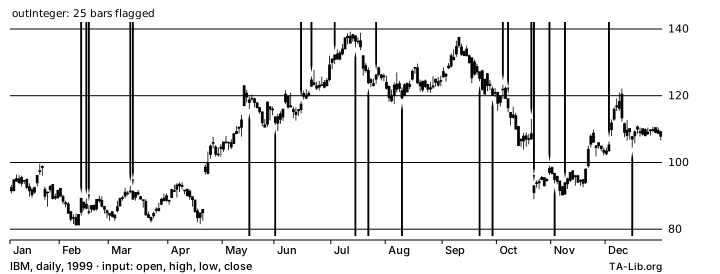
Chart metadata i
Outputs
outInteger:pattern_bull_bear·zero·positive·negative·pattern_confirm
Notes
- The name comes from the Japanese word for a deceptive move or "trap" — fitting, since the pattern exists to catch traders acting on a false breakout. Bulkowski's testing of the confirmed pattern found the trap itself barely beats a coin flip: the bullish variant continues as expected only 52% of the time and the bearish variant exactly 50% ("random"), both ranking in the bottom fifth (83rd-84th of 105) for post-breakout performance. (thepatternsite.com)
- A bar that is both a new setup and the confirmation of an earlier one reports the new setup; the earlier one ends unconfirmed.
Inputs
inOpen— Open price of each barinHigh— High price of each barinLow— Low price of each barinClose— Close price of each bar
Outputs
outInteger— +100/-100 at the hikkake (breakout) bar for bull/bear; +200/-200 at a later confirmation bar; 0 otherwise
Output Values
What candlestick values mean: Candlestick Outputs. The function's flags declare which values it can return: rW7.
| Value | Meaning |
|---|---|
| -200 | Bearish Hikkake confirmed: within 3 bars, a close below the inside bar's low validates the trap and the move lower |
| -100 | Bearish Hikkake — a false upside breakout from a tight, inside-bar range traps buyers before price turns back down |
| 0 | No pattern on this bar; a setup may still be awaiting confirmation |
| 100 | Bullish Hikkake — a false downside breakout from a tight, inside-bar range traps sellers before price turns back up |
| 200 | Bullish Hikkake confirmed: within 3 bars, a close above the inside bar's high validates the trap and the move higher |
Properties
Numerical Stability: Start-Independent
| ☐ Overlap Input |
| ✅ Independent Y-Axis i |
| ✅ Candlestick i |
| ☐ Display Shift |
| ☐ Can Output NaN or ±Inf |
| ☐ Identity at Period 1 |
| ☐ Uses Transcendental |
| ☐ Input Must Be Positive |
Example
C
#include <stdio.h>
#include <ta_libc.h>

int n = 252;
double open[252]; /* your data, oldest first */
double high[252]; /* your data, oldest first */
double low[252]; /* your data, oldest first */
double close[252]; /* your data, oldest first */
int out[252];
int outBegIdx, outNBElement;

TA_Initialize();
TA_CDLHIKKAKE( 0, n - 1, open, high, low, close, &outBegIdx, &outNBElement, out );
printf( "%d values from bar %d; last out = %d\n", outNBElement, outBegIdx, out[outNBElement - 1] );
Rust
use ta_lib::Core;

let open = vec![0.0; 252]; // your data, oldest first
let high = vec![0.0; 252]; // your data, oldest first
let low = vec![0.0; 252]; // your data, oldest first
let close = vec![0.0; 252]; // your data, oldest first
let mut out = vec![0i32; 252];

let core = Core::new();
let range = core.cdlhikkake(0, open.len() - 1, &open, &high, &low, &close, &mut out)?;
println!("{} values from bar {}; last out = {}", range.count, range.beg_idx, out[range.count - 1]);
Java
import io.github.talib.Core;
import io.github.talib.OutRange;

double[] open = new double[252]; // your data, oldest first
double[] high = new double[252]; // your data, oldest first
double[] low = new double[252]; // your data, oldest first
double[] close = new double[252]; // your data, oldest first
int[] out = new int[252];

Core core = Core.DEFAULT;
OutRange r = core.cdlhikkake(0, open.length - 1, open, high, low, close, out);
System.out.println(r.count() + " values from bar " + r.begIdx() + "; last out = " + out[r.count() - 1]);
C#
using System;
using TALib;

var open = new double[252]; // your data, oldest first
var high = new double[252]; // your data, oldest first
var low = new double[252]; // your data, oldest first
var close = new double[252]; // your data, oldest first
var outInteger = new int[252];

var core = Core.Default;
OutRange r = core.Cdlhikkake(0, open.Length - 1, open, high, low, close, outInteger);
Console.WriteLine($"{r.Count} values from bar {r.BegIdx}; last outInteger = {outInteger[r.Count - 1]}");
TypeScript
import { cdlhikkake } from 'ta-lib';

const open = new Float64Array(252); // your data, oldest first
const high = new Float64Array(252); // your data, oldest first
const low = new Float64Array(252); // your data, oldest first
const close = new Float64Array(252); // your data, oldest first

const { begIdx, values } = cdlhikkake({ open, high, low, close });
console.log(values.length + ' values from bar ' + begIdx + '; last values = ' + values[values.length - 1]);
Implementation
Added in 0.4.0.
TA-Lib Definition: cdlhikkake.c · cdlhikkake.yaml
| Native | File |
|---|---|
| C | ta_CDLHIKKAKE.c |
| Rust | cdlhikkake.rs |
| Java | Core_CDLHIKKAKE.java |
| C# | Core_CDLHIKKAKE.cs |
| TypeScript | cdlhikkake.ts |
Python: talib.CDLHIKKAKE, see ta-lib-python.
TA-Lib is also available for R and more using a wrapper.
Aliases
Hikkake Pattern, Hikkake