Engulfing Pattern (CDLENGULFING)
Summary
A two-candle reversal pattern where the second candle's real body engulfs the first candle's opposite-colored real body. Bullish (white engulfs black) or bearish (black engulfs white) reversal signal; ideally after a downtrend (bullish) or uptrend (bearish), which the code does not verify.
Chart
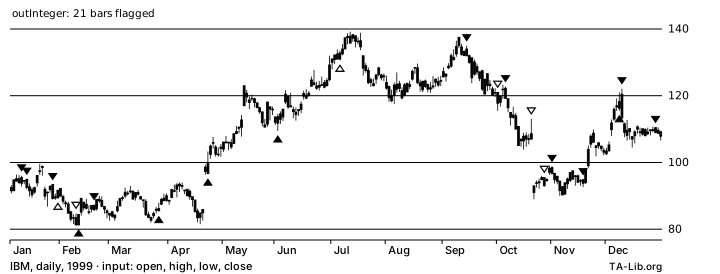
Chart metadata i
Outputs
outInteger:line·pattern_bull_bear·zero·positive·negative·pattern_weak
Notes
- Does not verify the prior trend (down for bullish, up for bearish) the reversal classically assumes.
- Bulkowski's testing found bearish Engulfing has a strong 79% reversal rate (5th-best of 103 patterns by that measure alone) but a weak overall post-breakout performance rank of 91st of 103 — the reversal fires reliably but rarely sustains. Bullish Engulfing reverses 63% of the time with a similarly weak overall rank of 84th of 103. (thepatternsite.com)
Inputs
inOpen— Open price of each barinHigh— High price of each barinLow— Low price of each barinClose— Close price of each bar
Outputs
outInteger— +100/+80 (bullish, white engulfs black), -100/-80 (bearish, black engulfs white), 0 otherwise. Magnitude 100 when the second body strictly engulfs both ends; 80 when the bodies share an exact endpoint (open[i]==close[i-1] or close[i]==open[i-1])
Output Values
What candlestick values mean: Candlestick Outputs. The function's flags declare which values it can return: rW7.
| Value | Meaning |
|---|---|
| -100 | Bearish engulfing: the black body fully swallows the prior white body — a strong reversal signal |
| -80 | Bearish engulfing, weaker variant: one edge of the two bodies lines up exactly rather than fully overhanging it |
| 0 | No pattern |
| 80 | Bullish engulfing, weaker variant: one edge of the two bodies lines up exactly rather than fully overhanging it |
| 100 | Bullish engulfing: the white body fully swallows the prior black body — a strong reversal signal |
Properties
Numerical Stability: Start-Independent
| ☐ Overlap Input |
| ✅ Independent Y-Axis i |
| ✅ Candlestick i |
| ☐ Display Shift |
| ☐ Can Output NaN or ±Inf |
| ☐ Identity at Period 1 |
| ☐ Uses Transcendental |
| ☐ Input Must Be Positive |
Example
C
#include <stdio.h>
#include <ta_libc.h>

int n = 252;
double open[252]; /* your data, oldest first */
double high[252]; /* your data, oldest first */
double low[252]; /* your data, oldest first */
double close[252]; /* your data, oldest first */
int out[252];
int outBegIdx, outNBElement;

TA_Initialize();
TA_CDLENGULFING( 0, n - 1, open, high, low, close, &outBegIdx, &outNBElement, out );
printf( "%d values from bar %d; last out = %d\n", outNBElement, outBegIdx, out[outNBElement - 1] );
Rust
use ta_lib::Core;

let open = vec![0.0; 252]; // your data, oldest first
let high = vec![0.0; 252]; // your data, oldest first
let low = vec![0.0; 252]; // your data, oldest first
let close = vec![0.0; 252]; // your data, oldest first
let mut out = vec![0i32; 252];

let core = Core::new();
let range = core.cdlengulfing(0, open.len() - 1, &open, &high, &low, &close, &mut out)?;
println!("{} values from bar {}; last out = {}", range.count, range.beg_idx, out[range.count - 1]);
Java
import io.github.talib.Core;
import io.github.talib.OutRange;

double[] open = new double[252]; // your data, oldest first
double[] high = new double[252]; // your data, oldest first
double[] low = new double[252]; // your data, oldest first
double[] close = new double[252]; // your data, oldest first
int[] out = new int[252];

Core core = Core.DEFAULT;
OutRange r = core.cdlengulfing(0, open.length - 1, open, high, low, close, out);
System.out.println(r.count() + " values from bar " + r.begIdx() + "; last out = " + out[r.count() - 1]);
C#
using System;
using TALib;

var open = new double[252]; // your data, oldest first
var high = new double[252]; // your data, oldest first
var low = new double[252]; // your data, oldest first
var close = new double[252]; // your data, oldest first
var outInteger = new int[252];

var core = Core.Default;
OutRange r = core.Cdlengulfing(0, open.Length - 1, open, high, low, close, outInteger);
Console.WriteLine($"{r.Count} values from bar {r.BegIdx}; last outInteger = {outInteger[r.Count - 1]}");
TypeScript
import { cdlengulfing } from 'ta-lib';

const open = new Float64Array(252); // your data, oldest first
const high = new Float64Array(252); // your data, oldest first
const low = new Float64Array(252); // your data, oldest first
const close = new Float64Array(252); // your data, oldest first

const { begIdx, values } = cdlengulfing({ open, high, low, close });
console.log(values.length + ' values from bar ' + begIdx + '; last values = ' + values[values.length - 1]);
Implementation
Added in 0.4.0.
TA-Lib Definition: cdlengulfing.c · cdlengulfing.yaml
| Native | File |
|---|---|
| C | ta_CDLENGULFING.c |
| Rust | cdlengulfing.rs |
| Java | Core_CDLENGULFING.java |
| C# | Core_CDLENGULFING.cs |
| TypeScript | cdlengulfing.ts |
Python: talib.CDLENGULFING, see ta-lib-python.
TA-Lib is also available for R and more using a wrapper.
Aliases
Engulfing Pattern, Engulfing, Bullish/Bearish Engulfing