Three Stars In The South (CDL3STARSINSOUTH)
Summary
A three-candle bullish reversal pattern of three consecutive black candles that progressively shrink and stabilize: a long black candle with a long lower shadow, a smaller black candle probing lower, then a small black marubozu contained within the second candle's range. A hit signals a bullish reversal; it is meaningful in a downtrend, which the function does not verify.
Chart
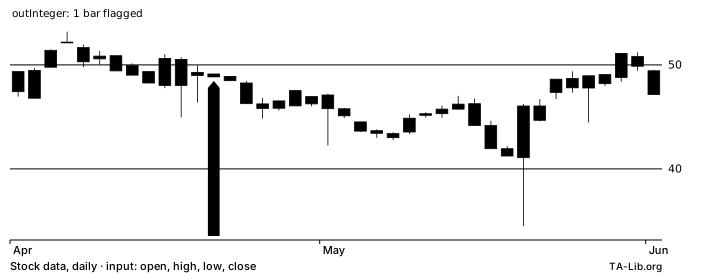
Chart metadata i
Outputs
outInteger:pattern_bull_bear·zero·positive
Notes
- Does not verify the prior downtrend the pattern classically assumes for significance.
- Thomas Bulkowski's statistical study found this has the best reversal rate of the 103 candlestick patterns he tracked (86% bullish reversal) — but that rests on just 9 occurrences in 4.7 million candle lines, and its overall post-breakout performance ranks dead last, 103rd of 103. (thepatternsite.com)
- Rare: a few years of one symbol's daily bars may show none. Bulkowski ranks it 99th of 103 patterns by how often it occurs (Three Stars in the South).
Inputs
inOpen— Open price of each barinHigh— High price of each barinLow— Low price of each barinClose— Close price of each bar
Outputs
outInteger— +100 on the bar where the pattern completes (always bullish), 0 otherwise. Never emits -100
Output Values
What candlestick values mean: Candlestick Outputs. The function's flags declare which values it can return: rW7.
| Value | Meaning |
|---|---|
| 0 | No pattern |
| 100 | Three Stars In The South detected — a bullish bottom-reversal signal, most meaningful after a downtrend (unverified by the function) |
Properties
Numerical Stability: Start-Independent
| ☐ Overlap Input |
| ✅ Independent Y-Axis i |
| ✅ Candlestick i |
| ☐ Display Shift |
| ☐ Can Output NaN or ±Inf |
| ☐ Identity at Period 1 |
| ☐ Uses Transcendental |
| ☐ Input Must Be Positive |
Example
C
#include <stdio.h>
#include <ta_libc.h>

int n = 252;
double open[252]; /* your data, oldest first */
double high[252]; /* your data, oldest first */
double low[252]; /* your data, oldest first */
double close[252]; /* your data, oldest first */
int out[252];
int outBegIdx, outNBElement;

TA_Initialize();
TA_CDL3STARSINSOUTH( 0, n - 1, open, high, low, close, &outBegIdx, &outNBElement, out );
printf( "%d values from bar %d; last out = %d\n", outNBElement, outBegIdx, out[outNBElement - 1] );
Rust
use ta_lib::Core;

let open = vec![0.0; 252]; // your data, oldest first
let high = vec![0.0; 252]; // your data, oldest first
let low = vec![0.0; 252]; // your data, oldest first
let close = vec![0.0; 252]; // your data, oldest first
let mut out = vec![0i32; 252];

let core = Core::new();
let range = core.cdl3starsinsouth(0, open.len() - 1, &open, &high, &low, &close, &mut out)?;
println!("{} values from bar {}; last out = {}", range.count, range.beg_idx, out[range.count - 1]);
Java
import io.github.talib.Core;
import io.github.talib.OutRange;

double[] open = new double[252]; // your data, oldest first
double[] high = new double[252]; // your data, oldest first
double[] low = new double[252]; // your data, oldest first
double[] close = new double[252]; // your data, oldest first
int[] out = new int[252];

Core core = Core.DEFAULT;
OutRange r = core.cdl3starsinsouth(0, open.length - 1, open, high, low, close, out);
System.out.println(r.count() + " values from bar " + r.begIdx() + "; last out = " + out[r.count() - 1]);
C#
using System;
using TALib;

var open = new double[252]; // your data, oldest first
var high = new double[252]; // your data, oldest first
var low = new double[252]; // your data, oldest first
var close = new double[252]; // your data, oldest first
var outInteger = new int[252];

var core = Core.Default;
OutRange r = core.Cdl3starsinsouth(0, open.Length - 1, open, high, low, close, outInteger);
Console.WriteLine($"{r.Count} values from bar {r.BegIdx}; last outInteger = {outInteger[r.Count - 1]}");
TypeScript
import { cdl3starsinsouth } from 'ta-lib';

const open = new Float64Array(252); // your data, oldest first
const high = new Float64Array(252); // your data, oldest first
const low = new Float64Array(252); // your data, oldest first
const close = new Float64Array(252); // your data, oldest first

const { begIdx, values } = cdl3starsinsouth({ open, high, low, close });
console.log(values.length + ' values from bar ' + begIdx + '; last values = ' + values[values.length - 1]);
Implementation
Added in 0.4.0.
TA-Lib Definition: cdl3starsinsouth.c · cdl3starsinsouth.yaml
| Native | File |
|---|---|
| C | ta_CDL3STARSINSOUTH.c |
| Rust | cdl3starsinsouth.rs |
| Java | Core_CDL3STARSINSOUTH.java |
| C# | Core_CDL3STARSINSOUTH.cs |
| TypeScript | cdl3starsinsouth.ts |
Python: talib.CDL3STARSINSOUTH, see ta-lib-python.
TA-Lib is also available for R and more using a wrapper.
Aliases
Three Stars In The South